Family Game Night
How to Choose and Run a Printable Escape Room for Family Game Night
A practical host guide to choosing, printing, setting up, hinting, and running a family escape-room game without locks, apps, or room staging.
The short answer
Choose a printable escape room by matching four things: the youngest active solver, the group size, the time you can protect, and the amount of host preparation you will actually do. For a relaxed family night, a tabletop kit with a separate answer key and graduated hints is usually easier to run than a game that asks you to hide props around the house.
1. Choose the game by the people at the table
Age labels are only a starting point. Reading load, puzzle familiarity, frustration tolerance, and whether adults will play alongside children matter more. If the youngest player cannot read the clues independently, give that player a concrete role: page finder, symbol spotter, timer helper, or answer recorder.
| Decision | Lower-friction choice | Choose more complexity when… |
|---|---|---|
| Setup | Tabletop pages in sequence | The host enjoys hiding props and resetting rooms |
| Length | 20–35 minutes | The group regularly plays longer puzzle games |
| Clue access | One clue at a time | Players can divide work without losing the story |
| Hints | Tiered nudges before answers | The host is comfortable improvising clues |
For mixed ages, do not turn every puzzle into a speed contest. A shared finish is usually more satisfying than watching one experienced solver race ahead.
2. Prepare the game in 10 minutes, not an afternoon
- Read the host guide and final answer first. You need to recognize whether a player is close, not memorize every solution.
- Print the correct paper size. Use “actual size” or the kit’s stated print setting. Print one-sided unless instructions explicitly say otherwise.
- Separate player pages from host-only pages. Put hints and answers in a folder or face down beside you.
- Test the opening clue. Confirm it is legible and that no page was cropped.
- Set expectations. Tell players how long they have, whether phones are allowed, and how hints work.
A pencil, scrap paper, timer, and a clear table are usually enough for a tabletop game. Extra envelopes and decorations can add atmosphere, but they should not become a requirement unless the kit says so.
3. Use a simple host script
“You have 30 minutes. Everything needed is on the printed pages. You may write on the puzzle sheets. If you want help, ask for Hint 1 before Hint 2. The goal is to solve together, not to avoid every hint.”
Start the timer only after everyone understands the first action. During play, watch for participation rather than silence. If one person controls every page, hand the next clue to a different reader or ask the group to explain its reasoning before submitting an answer.
Two useful play modes
- Sequential mode: release the next page after the current answer. This protects the story and is easiest for new players.
- Open-table mode: place several pages out at once. This works for larger or more experienced groups that can divide tasks.
Do not switch modes halfway unless the group is stuck because of access rather than difficulty.
4. Treat hints as pacing tools
A good hint preserves the small moment of discovery. Use a three-step ladder: first point players toward the relevant information, then name the operation or relationship, and only then reveal the answer. Wait a minute between levels.
Intervene when the group has repeated the same unproductive action, misread a printing artifact, or stopped talking. Do not intervene merely because the solution is taking longer than you expected. At the end, ask which clue created the best “aha” moment and which instruction was unclear; that tells you how to host the next game better.
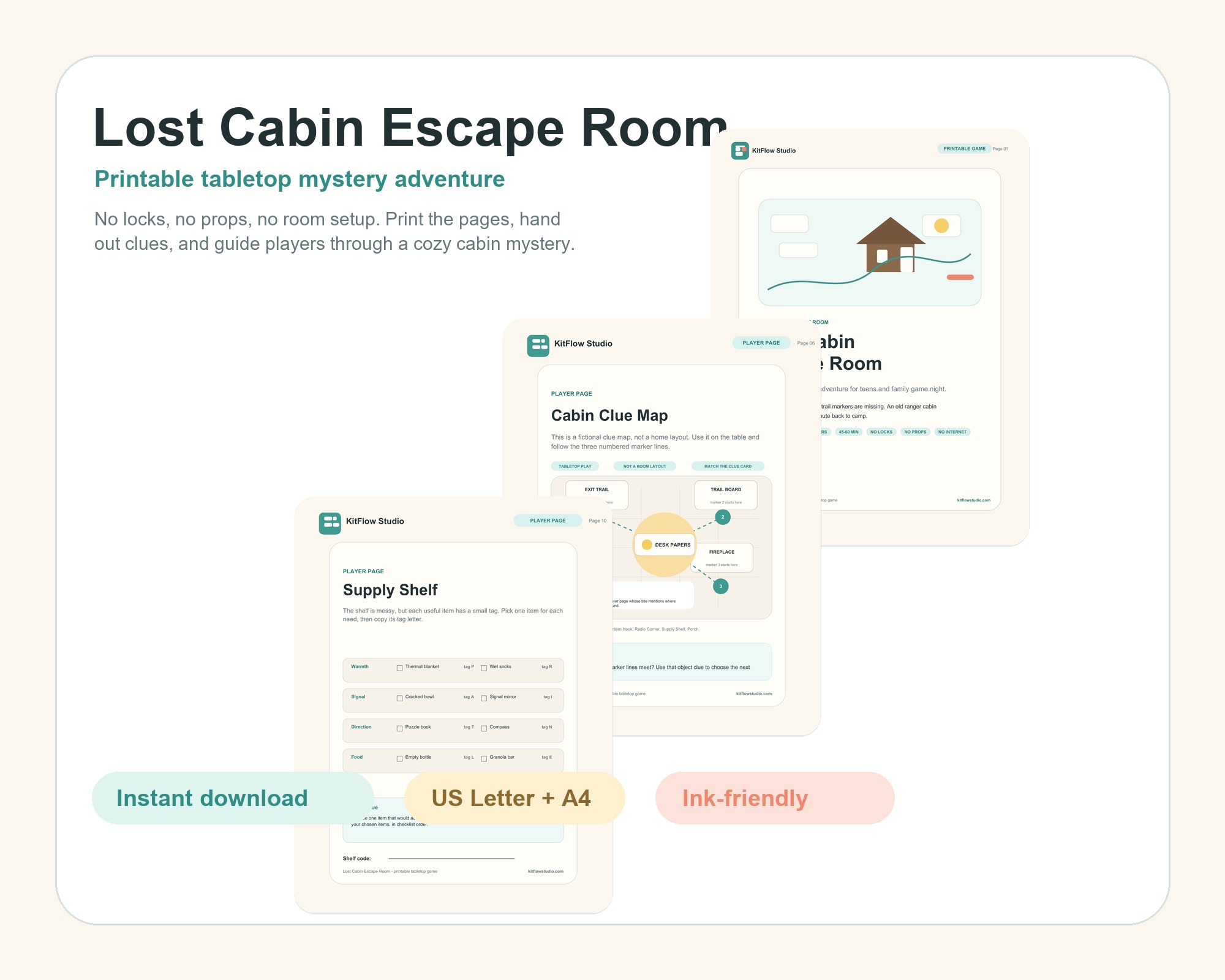
If you want a ready-to-print version, the Lost Cabin escape room is a 20–35 minute tabletop game for ages 10+ with Letter/A4 and ink-friendly files, a host guide, hints, and an answer key. It does not require locks, apps, or physical room setup.
Frequently asked questions
How many copies should I print?
For one small group, one player set is normally enough, but duplicate any page that several people need to inspect closely. Keep the host guide and answer pages separate.
Can younger children join?
Yes, with a role matched to their reading and puzzle level. The advertised age should describe independent participation, not whether a younger sibling may help.
Should we use a hard time limit?
Use a timer for energy, but decide in advance whether time expiry ends the game or simply triggers an extra hint. For a family night, finishing the story is often the better goal.