Client Operations
A Practical Client Onboarding Checklist for Virtual Assistants
A repeatable VA onboarding checklist for scope, access, SOPs, recurring tasks, escalation, handoff, and offboarding—without storing client secrets.
The short answer
A VA onboarding checklist should create an accepted operating agreement: scope, request channel, priority rules, approval boundaries, secure access method, recurring deliverables, evidence of completion, escalation, and handoff. A welcome email is not onboarding if the assistant still has to guess how work enters or how “done” is accepted.
1. Agree on the operating boundary before granting access
- Services included, excluded, and requiring a new quote
- Working hours, time zone, and expected response window
- Primary request channel and emergency channel
- Who may assign work and who approves outputs
- Spending, publishing, deletion, customer-contact, and account-change boundaries
- Expected monthly or weekly capacity
Write approval boundaries with examples. “Use judgment” is not enough for actions that affect customers, money, public content, or irreversible records.
2. Define how work moves
| Stage | Minimum information | Exit condition |
|---|---|---|
| Intake | Outcome, requester, due date, source files, constraints | Assistant confirms clarity and priority |
| Work | SOP, access, examples, approval boundary | Draft or task reaches review state |
| Review | Link, evidence, open question, recommended next step | Approver accepts or returns specific feedback |
| Close | Final location, completion date, follow-up | Record is searchable and ownership is clear |
Choose one source of truth for active requests. Email, chat, and voice messages may initiate work, but the accepted task should be captured where status and ownership can be seen.
Set a priority rule
Define what counts as urgent and who can declare it. A useful rule might be: service outage or same-day customer harm is urgent; a stakeholder’s late request is not automatically urgent. When two due dates conflict, the VA escalates rather than silently choosing.
3. Test each SOP with a real, low-risk task
A reliable SOP includes trigger, inputs, numbered steps, decision points, approval points, completion evidence, storage location, and exception path. During onboarding, run one representative task in a sandbox or low-risk context. Watch where the assistant must ask a question; that is evidence the SOP or boundary needs improvement.
Do not copy passwords into an onboarding workbook or SOP. Use the client’s approved password manager, role-based access, and least privilege. Record that access was requested, granted, tested, and later revoked—not the secret itself.
4. Design handoff and offboarding at the beginning
- Where final files and work history live
- Naming conventions and version rules
- Which recurring dates must be transferred
- Who owns each external account
- How access is revoked and confirmed
- What remains confidential after the engagement
- What deliverables require final client acceptance
Good handoff is not a folder dump. It should let another authorized person identify current status, next deadlines, unresolved risks, and where evidence lives.
Worked example: weekly newsletter support
This example makes delay ownership and public-action authority explicit.
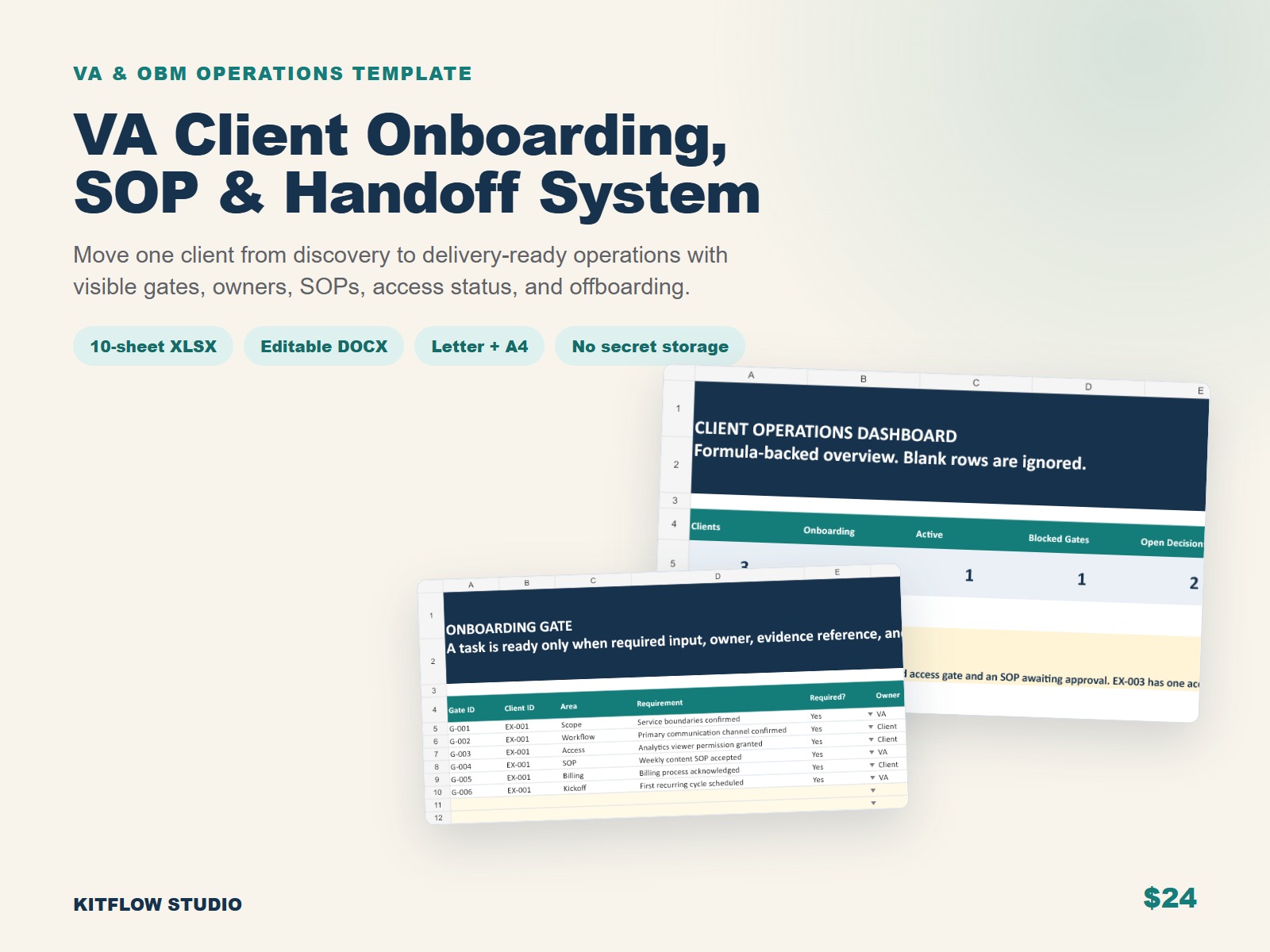
The VA Client Onboarding, SOP & Handoff System provides a structured workspace for scope, access status, SOP ownership, recurring tasks, escalation, acceptance, and offboarding. Adapt it to the client’s tools and contract.
Frequently asked questions
What should happen on the first onboarding call?
Confirm goals, scope, communication, owners, approval boundaries, first representative task, and the access plan. Do not spend the entire call touring tools without agreeing how work will move.
How long should VA onboarding take?
It depends on risk and complexity. A narrow recurring task may be validated quickly; financial, customer-facing, or multi-system work deserves staged access and supervised checks.
Is this a contract?
No. An onboarding checklist supports operations but does not replace a service agreement, confidentiality terms, data-processing requirements, or professional legal advice.