People Operations
How to Build a 30-60-90 Day Onboarding Plan with Owners and Evidence
Turn a new-hire checklist into a 30-60-90 day onboarding plan with measurable outcomes, named owners, evidence, and useful check-ins.
The short answer
A useful 30-60-90 plan describes what the new hire should understand, perform, and own—not merely which meetings they attend. For every outcome, name the responsible support person, the evidence that shows progress, and the date when manager and employee will review it.
Start with outcomes, then add tasks
“Attend product training” is a task. “Explain the three main customer use cases and route an out-of-scope request correctly” is an outcome. Tasks can support an outcome, but completion alone does not prove readiness.
Use this sentence pattern: By [date], the new hire can [observable action] under [realistic condition], evidenced by [artifact, demonstration, or result].
Keep the evidence proportionate. A role-play, reviewed draft, completed system workflow, or short teach-back can be more useful than another checkbox.
Give each phase a different job
| Phase | Main purpose | Useful evidence |
|---|---|---|
| Days 1–30 | Context, relationships, systems, safe practice | Teach-back, supervised workflow, stakeholder map |
| Days 31–60 | Independent repetition and feedback | Completed work sample, quality review, resolved blocker |
| Days 61–90 | Ownership, prioritization, improvement | Owned deliverable, operating rhythm, improvement proposal |
Do not force every goal into all three phases. Access setup belongs early; ownership of a recurring process belongs later. Also distinguish the employee owner from the enablement owner who must provide access, training, or approval.
Worked example: customer support specialist
| When | Outcome | Enablement owner | Evidence |
|---|---|---|---|
| Day 30 | Classify common requests and explain escalation boundaries | Support lead | Reviewed scenario exercise |
| Day 60 | Resolve standard tickets independently at expected quality | Assigned buddy | Sample quality review and coaching notes |
| Day 90 | Own one queue rhythm and identify one recurring friction point | Manager | Queue handoff plus improvement brief |
Notice what is absent: invented numerical targets. Add volume, speed, or quality thresholds only when the organization has a real baseline and the employee has the tools to influence the result.
Use check-ins to remove friction, not reread the tracker
A weekly 20-minute check-in can follow four prompts:
- Which outcome moved, and what evidence exists?
- What is blocked by access, clarity, capacity, or another person?
- What feedback should change next week’s practice?
- Does any day-60 or day-90 outcome need to be revised?
Record the decision and owner for each blocker. If a manager delays system access, that is not a new-hire performance failure. A good tracker makes this distinction visible.
Close day 90 with an accepted handoff
Review owned responsibilities, remaining training, access still required, recurring check-ins, and the next performance period. Both manager and employee should understand what “business as usual” now means.
Keep HR and privacy boundaries clear
A planning template is not employment, legal, immigration, accessibility, or performance-management advice. Align the plan with organizational policy and applicable law. Store only operational information needed for onboarding; keep sensitive identity, medical, payroll, and protected personnel information in approved systems.
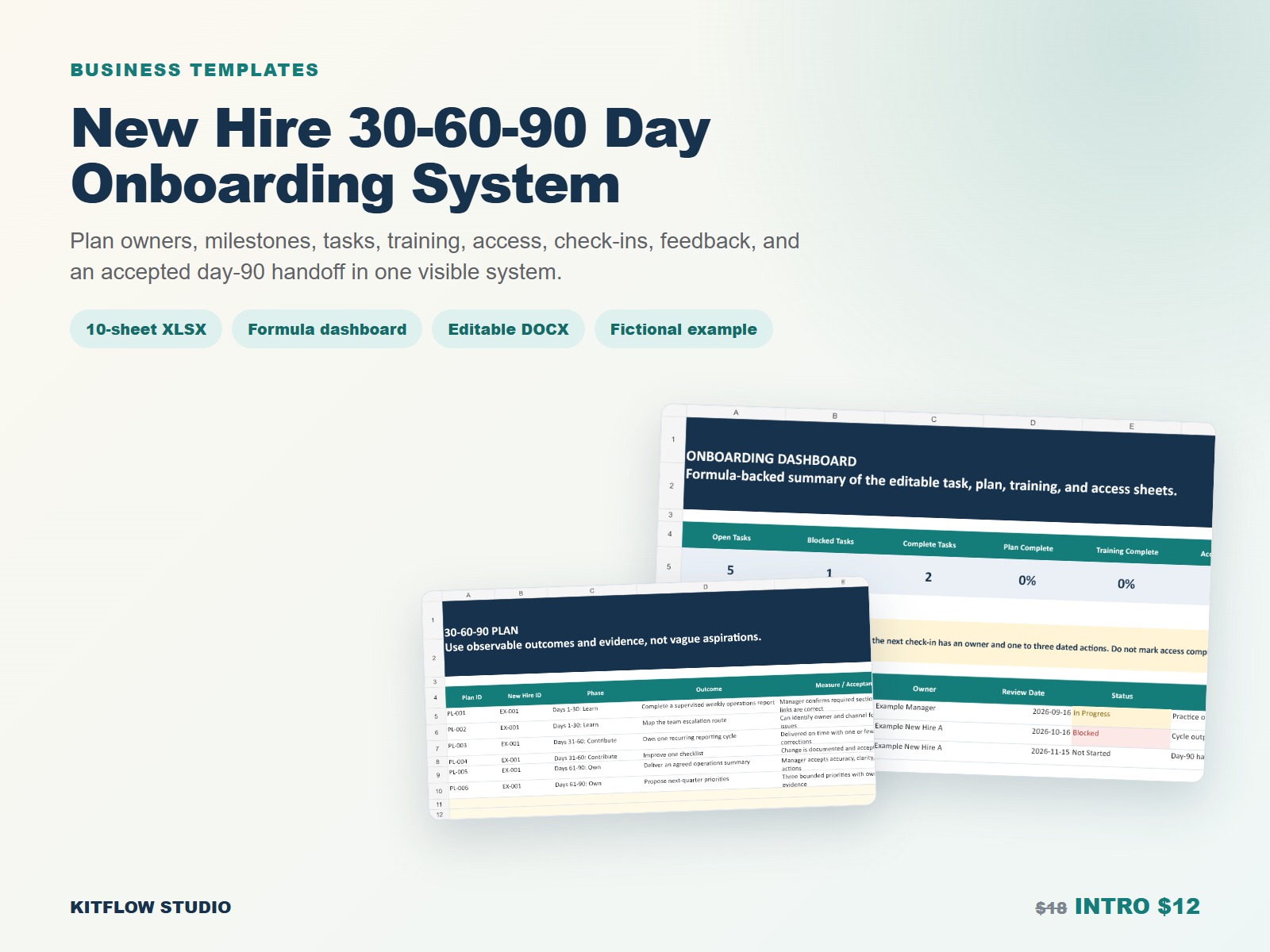
The New Hire 30-60-90 Day Onboarding System combines an Excel tracker, editable guide, printable PDFs, and fictional examples. Its full dashboard and registers are designed for desktop Excel; printouts work best as meeting companions rather than as a replacement for the working file.
Frequently asked questions
Is a 30-60-90 plan only for managers?
No. The depth changes by role, but the same outcome-owner-evidence structure works for individual contributors.
Can the plan change?
Yes. Revise it when business priorities or role knowledge changes, and record why. Quietly moving a goal after the fact destroys trust.
How many outcomes should each phase have?
Use the smallest number that describes meaningful progress. Three to five major outcomes per phase is often easier to manage than dozens of micro-tasks.