Family Gatherings
15 Family Reunion Games for All Ages (Plus a 30-Minute Plan)
Fifteen family reunion games with practical setup notes, mixed-age adaptations, and a host plan that avoids awkward forced participation.
The short answer
The best reunion lineup is not the longest list. Choose one easy arrival activity, one shared team game, and one optional memory activity. Let people watch without penalty, avoid games that depend on private family knowledge, and offer seated roles so different ages and mobility levels can participate.
Choose with four filters
- Group shape: toddlers, teens, older adults, and people meeting for the first time need flexible roles.
- Space: a living room, picnic shelter, and restaurant private room support different movement levels.
- Noise: conversation-based games fail when half the group cannot hear instructions.
- Emotional safety: skip prompts about money, relationships, health, politics, grief, or “most embarrassing” stories unless your group explicitly wants them.
15 family reunion games that adapt
- Name-and-connection cards (5–10 min): each person shares a name and one low-stakes connection, such as favorite snack. Younger players may draw.
- Find-someone-who grid (10–15 min): use observable or voluntary prompts. Offer a seated interviewer role.
- Family-friendly trivia teams (15 min): mix general knowledge with a few verified family facts; avoid questions that shame people for not knowing.
- Photo timeline sort (10 min): teams place copied photos by decade. Label uncertain dates as estimates.
- Two-clue object hunt (10 min): search only within a defined safe area; pair children with adults.
- Tabletop category race (8 min): list foods, places, or songs beginning with a chosen letter. No running required.
- Collaborative story circle (10 min): each player adds one sentence; participants may pass.
- Memory postcard (10 min): write or draw one enjoyable gathering memory for a shared box.
- This-or-that corners (8 min): move, point, or hold up a card to choose between two harmless options.
- Family recipe match (10 min): match copied recipe names to ingredients or occasions, not to a person if attribution is disputed.
- Team doodle relay (10 min): pass one paper around a seated table, adding to a themed drawing.
- Guess the decade (10 min): use songs, inventions, or public events; let teams discuss before answering.
- Conversation card pairs (10–20 min): use prompts about favorites, skills, travel, or hopes; include a visible pass option.
- Mini talent teach-in (15 min): volunteers teach a two-minute skill rather than perform for judgment.
- Closing appreciation wall (10 min): write specific thanks for help given during the gathering, without requiring public speeches.
For every activity, decide in advance who explains it, which supplies are needed, how it ends, and what a non-playing guest can do comfortably.
A 30-minute plan that works for a mixed group
| Time | Activity | Host move |
|---|---|---|
| 0–5 | Name-and-connection cards | Model a 15-second answer and point out the pass option |
| 5–20 | Trivia or category teams | Build mixed-age teams and rotate the answer reader |
| 20–28 | Memory postcard | Offer writing or drawing; sharing is optional |
| 28–30 | Close | Thank helpers and say where cards will be kept |
For 60–90 minutes, add a break and one movement or photo activity. More games do not automatically create more connection.
Host participation without pressure
Say “join, help, or watch” before the first game. Give people useful non-player roles such as scorekeeper, photographer, card reader, supply helper, or timekeeper. Never make a person explain why they are sitting out.
Use large type, read rules aloud, demonstrate one sample turn, and keep a printed host sheet. If the host needs a laptop to remember the sequence, the activity is not truly gathering-friendly.
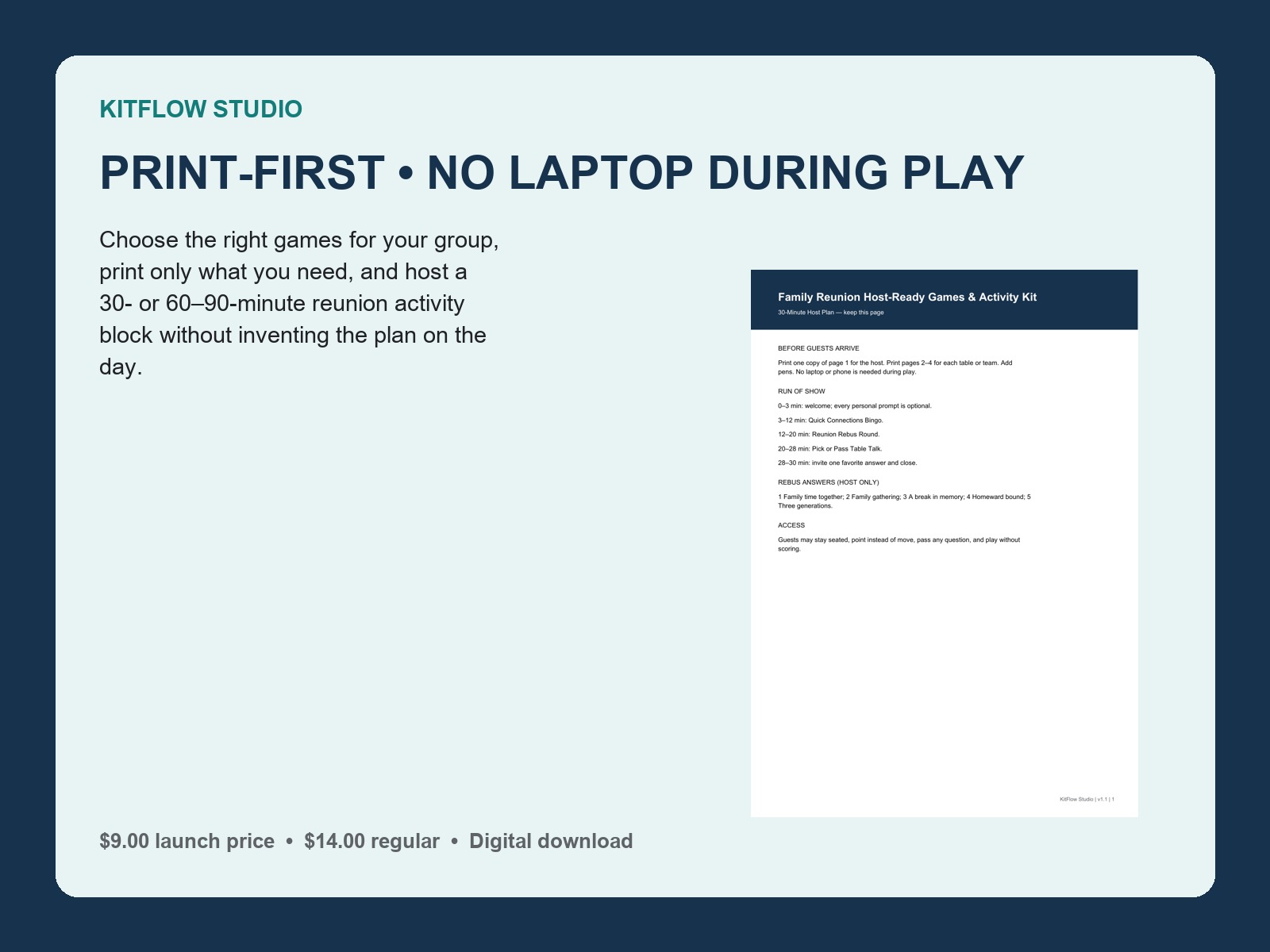
The Family Reunion Host-Ready Games & Activity Kit is print-first: it includes ten adaptable activities, quick 30-minute and 60–90-minute run plans, player packs, and a host guide. The editable trivia file is optional preparation; a computer is not needed during play.
Frequently asked questions
What if many relatives do not know each other?
Start with general preference or observation games. Save family-history questions until teams have context, and provide the answers as stories rather than tests of belonging.
How do we include older adults or guests with limited mobility?
Make every movement game playable by pointing, holding a card, or partnering. Check route surfaces and seating before announcing an activity.
Should winners receive prizes?
Small shared or humorous prizes can be fine, but prizes are optional. Avoid stakes that make rule disputes or knowledge gaps feel consequential.