A Two Player Print and Play Prototype Without Cutting
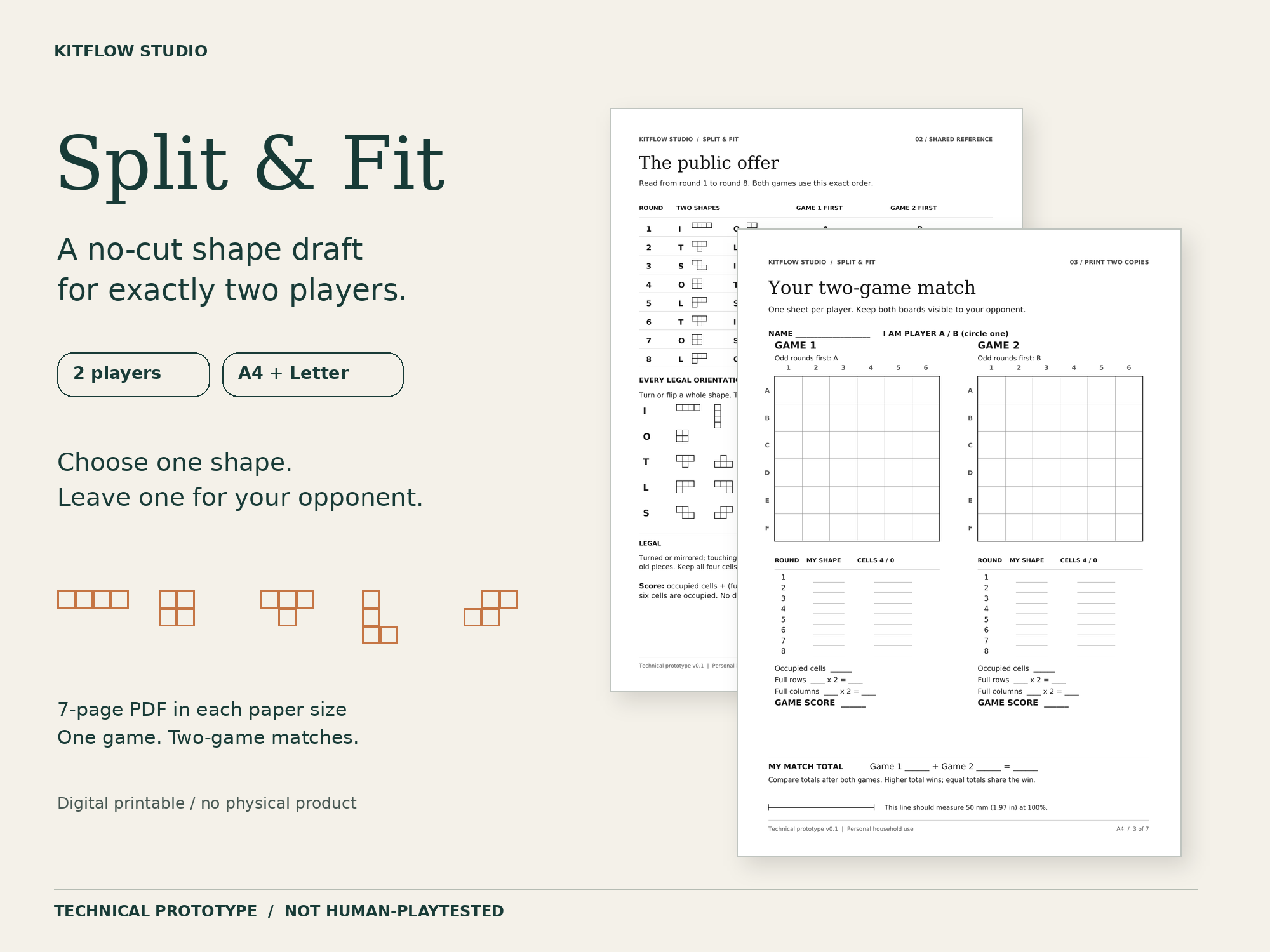
A two player print and play game can still involve cutting cards, sorting pieces, or finding extra equipment. If you would rather work directly on paper, check what a game actually asks you to prepare. “Printable” describes the file format; it does not tell you how much assembly comes next.
Split & Fit, a KitFlow Studio prototype, uses two pencils and printed sheets. It has no cut-out pieces. Before considering it, note the limits: there have been no human playtests or physical print checks. Age 10+ is a proposed starting point, and 20–30 minutes is an untested estimate for a full match. Enjoyment, rule clarity, and balance are not established.
What to check in no cut print and play games
Start with the equipment list. Does the game require dice, counters, a timer, or cards you must supply? Next, check how many sheets each person needs and whether instructions depend on double-sided printing. Finally, distinguish a short round from the full activity. An eight-round game may be only half a match.
For Split & Fit, each player gets one sheet containing two 6×6 boards. A shared reference shows all eight offers, so there is no shuffling or hidden draw. Both players’ boards remain visible. The full match requires two games; playing just one is practice, not the standard match format.
How the shape draft works
Each round offers two four-cell shapes. The named first-picker chooses one for their own board, leaving the other for their opponent. The five families are I, O, T, L, and S. Rotation and reflection are allowed, and the reference shows all 19 legal orientations.
Players place in first-picker order. Draw the assigned shape entirely inside four empty cells, writing the round number in each cell. A new piece can touch earlier pieces but cannot overlap them. Either player may pass voluntarily, even if a placement is possible. A passed shape is lost for that round; it cannot be saved. Once a placement is confirmed and the round moves on, earlier pieces stay put.
Try one real opening round
Use two empty 6×6 grids. Label the rows A–F from top to bottom and columns 1–6 from left to right. Player names A and B are separate from these cell labels.
Round 1 offers I and O, with Player A choosing first in Game 1. Player A takes I and draws it across A1, A2, A3, and A4 on their own board. Player B receives O and draws it in A1, A2, B1, and B2 on their separate board. Write 1 in each newly occupied cell.
Both placements are legal: each uses four connected cells inside its own board. The repeated coordinates do not create a collision because players have separate boards. Neither player has completed a six-cell row or column.
This is a one-round tutorial, not a complete match, an optimal opening recommendation, or a score to beat. The remaining seven rounds and the second game still have to be played under the full rules.
Count cells, then check complete lines
After eight rounds, count your occupied cells. Add 2 points for each complete row and 2 for each complete column. A complete row or column has all six cells occupied, regardless of the round numbers written there. Diagonals do not score. Do not erase completed lines.
Then use the second empty board. Repeat the same eight offers in the same order, but reverse the first-picker schedule for every round. Add your two game scores to get your match total. The higher total wins; equal totals produce a drawn match/shared win. Experiencing both schedules does not prove that human play is balanced.
Print only what you need
The package contains a 7-page A4 PDF and a 7-page US Letter PDF with identical content. Choose the size matching your paper. Print page 1 once, page 2 once, and page 3 twice, single-sided at actual size. Each copy of page 3 belongs to one player and contains both of that player’s game boards.
Pages 4–7 contain two worked matches and can be read on screen. They show legal play and scoring, not a unique solution. Physical print output has not been checked, so preview your printer settings.
Deciding whether to try the prototype
The fixed offers make the upcoming shapes visible, but they may also become familiar or repetitive. This version is for two people willing to explore an untested spatial game, not anyone expecting proven fairness, a guaranteed duration, or a validated age recommendation. The license is personal household use only, excluding classroom and commercial use, resale, and redistribution. The package is digital only; no physical product is included or shipped.