Office Farewell Party Agenda: 20, 30 or 45 Minutes
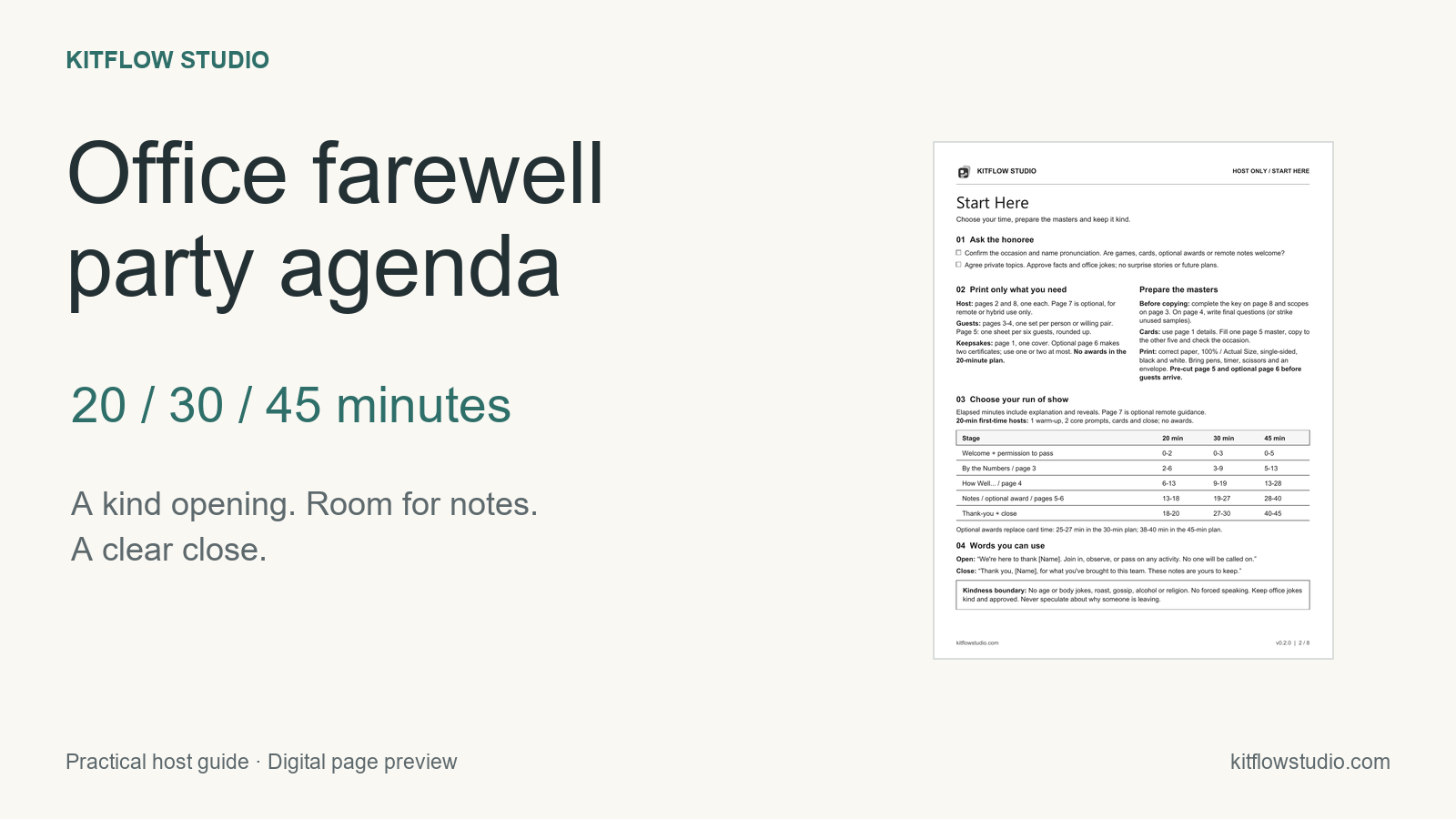
An office farewell can be warm without becoming a long round of speeches. Give it a clear opening, one short activity, time for written appreciation and a definite close.
The agendas below are planning templates for a retirement or a coworker leaving for a new role. Choose the length that fits the calendar, then remove anything the honoree would rather skip. These are suggested hosting plans, not measured results from group trials.
Ask the honoree before planning the surprise
Start with a private conversation. Ask whether they want a gathering at all, who should attend, how their name and occasion should appear, and whether they would welcome a short game, written notes or a certificate.
Check the boundaries around stories, photographs and future plans. A retirement announcement does not give the host permission to make age jokes. A new job does not mean the next employer, salary or reason for leaving is public information.
If they prefer a quiet goodbye, a card and a brief thank-you may be enough.
“We’d like to mark your time with the team. Would you enjoy a short gathering, or would you prefer something quieter? Are there any topics or activities you’d like us to leave out?”
Choose a 20, 30 or 45-minute agenda
All three plans follow the same sequence. The longer versions allow more time for answers and writing; they do not need more games.
| Segment | 20 minutes | 30 minutes | 45 minutes |
|---|---|---|---|
| Welcome and participation rule | 0–2 | 0–3 | 0–5 |
| By the Numbers warm-up | 2–6 | 3–9 | 5–13 |
| How Well Do You Know Them | 6–13 | 9–19 | 13–28 |
| Written memories or appreciation | 13–18 | 19–27 | 28–40 |
| Thank-you and close | 18–20 | 27–30 | 40–45 |
For a first-time host choosing 20 minutes, use one warm-up question and two core prompts. Leave certificates out of that plan. A smaller selection gives you room to explain the instructions and finish without rushing.
Keep refreshments outside the timed activity if serving them would interrupt the sequence.
Prepare the questions before making copies
Choose a few approved facts that colleagues can reasonably know. Record the answers or approved story cues before the event and check ambiguous wording.
For a numbers warm-up, you might use completed whole years on the team or the number of teams involved in an agreed project. Name the project or time period clearly. Do not use age, salary, sick days or anything drawn from private records.
For the main colleague quiz, choose work-focused prompts such as:
- Which project did they help bring over the line?
- Which workday routine did they say they enjoy?
- Which useful tip do teammates still use?
- Which skill are they excited to use next, if they have agreed to share it?
Ask the honoree to approve the next-chapter question. If a fact is unknown or a topic is unwelcome, cross it out on both the guest master and your host notes. Accept equivalent wording when sharing the approved answer; you do not need a score, ranking or prize.
If your worksheet has both a sample prompt and a blank for a local question, make the choice explicit: guests answer the sample when the local-question line is blank. If you replace a sample, write the final wording before copying.
Keep your answer notes with the host, separate from guest sheets.
Say the pass rule at the beginning
Do not wait for someone to look uncomfortable. Make participation optional before the first question.
“Thanks for joining us to celebrate [Name]. We’ll keep this short and kind. You’re welcome to answer, write a note, listen or pass. There’s no need to speak, and we’ll keep stories to things [Name] is comfortable sharing.”
Avoid age or body jokes, roasts, gossip and comments about alcohol or religion. An office joke belongs in the plan only when it is kind, understood in context and welcome to the person it concerns. You can leave the joke line blank.
If you need more general conversation prompts, our work-safe get-to-know-you questions guide offers a separate starting point. For this event, choose only what serves the goodbye.
Give written appreciation its own time
Written notes let someone contribute without addressing the room. Put out a card and pen for each person who wants one. Do not require names or ask guests to read their cards aloud.
For retirement, try: “A moment from working with you that I’ll remember…”
For a new role, try: “A strength you bring to your next team…”
Invite one specific example. “You explained a complicated process clearly when I was new” gives the honoree something concrete to keep.
Pre-cut the cards before guests arrive. If the same name, date and occasion appear on every card, agree those details once and copy them across the master before photocopying. Guests write their own messages; they do not need separate setup conversations.
Give the finished cards privately to the honoree. Ask before photographing or circulating anyone’s message.
Change the emphasis for retirement or a new role
For retirement, focus on contributions, things learned together and good wishes that do not assume what retirement will look like. Avoid promises that the person will now travel, provide childcare or stop working unless they have chosen to share those plans.
For Leaving Do / New Role, recognize what the colleague brought to the team and wish them well. Let them decide how much to say about the next step.
The host sequence can remain the same. Change the prompts and the occasion label to suit the person.
Fit optional certificates inside the agenda
A certificate can work when the honoree likes that kind of recognition. Choose a specific, kind title such as “Clear Explainer” and add one sentence about the contribution behind it.
Skip competitive rankings and backhanded compliments. Do not surprise someone with a public award they would dislike.
In the 30-minute plan, use minutes 25–27 within the notes block. In the 45-minute plan, use minutes 38–40. These replace part of the writing time; they do not add another segment.
Include remote colleagues without requiring a performance
Use the organization’s existing approved call or chat. Explain how remote colleagues can join, write privately or observe. Cameras and spoken answers should remain optional.
One host can read the same selected prompts. A remote colleague can send a private written note, or a photograph of a handwritten card with permission for it to be printed. Keep personal notes out of a public transcript.
Follow the same 20 or 30-minute clock. Do not add an extra remote round at the end. Agree who will gather permitted notes and pass them to the honoree.
Close on time
Give a short warning before the writing block ends, collect the cards and finish with a direct thank-you.
“[Name], thank you for what you’ve contributed to this team. We’ve gathered these notes for you to keep. We wish you well in your next chapter.”
If the event starts late, reduce the number of questions or skip the warm-up. Protect a little time for notes and a clear ending. Do not turn passing guests into an emergency speech rota.
A printable option
The Office Send-Off Host Kit brings this sequence into eight printable pages: a keepsake cover, host plans, one warm-up sheet, a colleague quiz, six-up memory cards, optional certificates, remote guidance and a host-only key.
The same eight designs are supplied in US Letter and A4. Names, dates and approved local details are filled in by hand. Use the parts that fit the honoree’s preferences. This guide can also be used on its own.
Questions hosts often ask
What if the honoree does not want games?
Skip them. Use the opening, optional written notes and closing. A farewell does not need a quiz to feel considered.
Should every colleague give a speech?
No. Written notes and quiet attendance are valid ways to participate. If a speech is wanted, arrange it in advance with someone who has agreed.
Can I use the same plan for retirement and a colleague changing jobs?
Yes. Keep the sequence and change the occasion wording and prompts. Ask what the honoree wants shared about their next chapter.
How much should I print?
Prepare a host copy, the guest sheets you have chosen and enough cut cards for people who may want to write. Keep the host answer key out of the guest pile. Check your printer’s settings on one copy before making the rest.