A Two-Player Picture Game You Can Play Behind a Folder
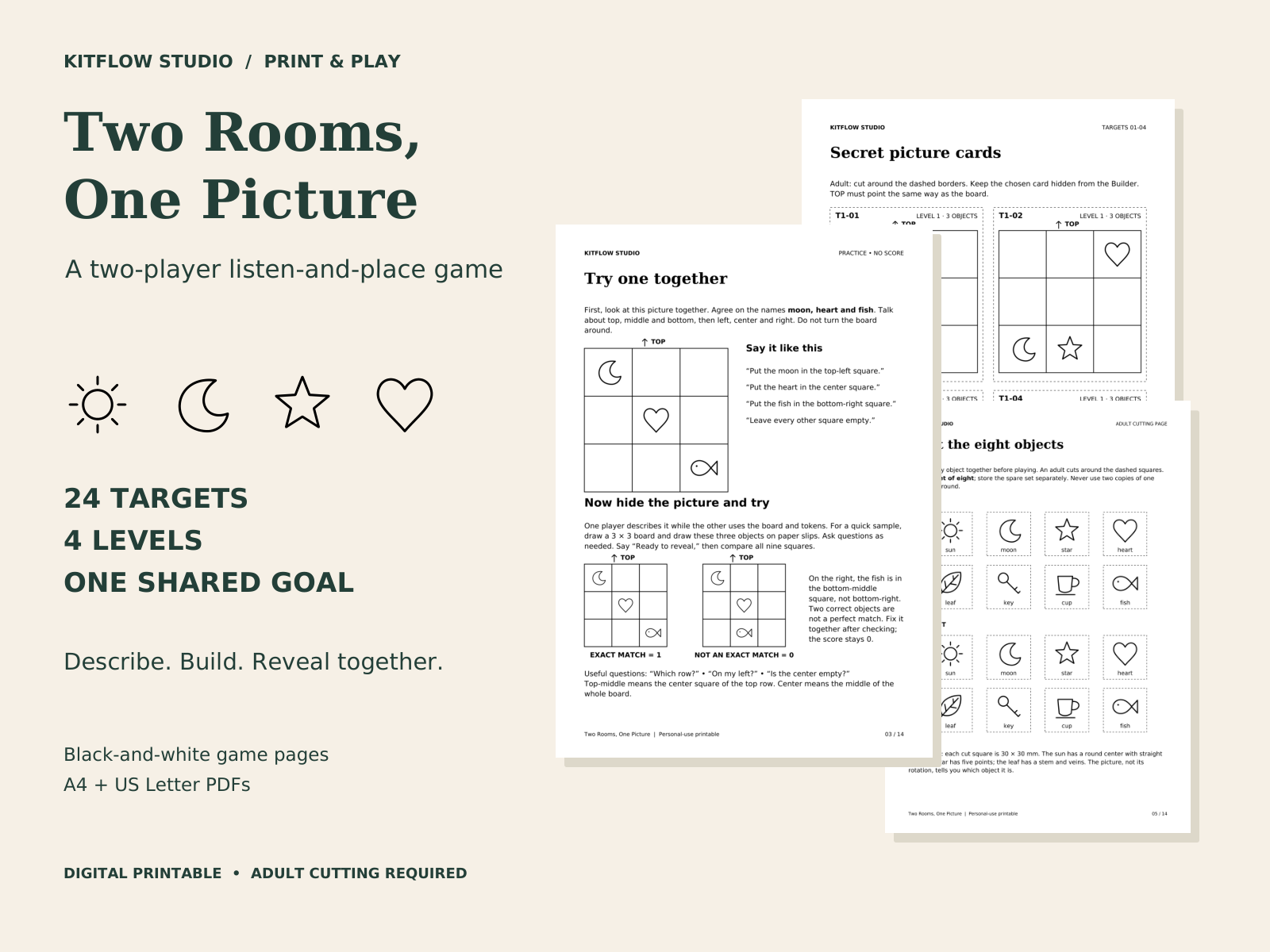
When there are only two of you at the table, you do not need a large team or a pile of trivia questions to have a shared challenge. A hidden picture, a few paper pieces and clear directions are enough to make a listen-and-place game.
The idea is simple. One player sees a small picture. The other tries to rebuild it without seeing the original. A folder between the paper spaces keeps the information separate. Both players work toward the same result rather than racing each other.
Set up the table so left means the same thing
Sit beside each other, facing the same way. Put a stable upright folder or book between your paper spaces. Mark the top of the target and the building board with arrows pointing away from you. If you sit face to face and both use your own left and right, it is easy to create an accidental mirror picture.
Use a three-by-three grid. Talk through top, middle and bottom, then left, center and right before hiding anything. Agree that “center” means the middle of the whole grid, while “top-middle” means the middle square in the top row.
Try this small picture first
Draw a moon in the top-left square, a heart in the center square and a fish in the bottom-right square. Leave all other squares empty. An adult can make three matching paper slips for the Builder, using pictures rather than requiring the child to read labels.
Look at the target together once. Name the three objects. Then place it behind the screen and start again with an empty building board.
The Describer might say:
“Put the moon in the top-left square.”
“Put the heart in the center square.”
“Put the fish in the bottom-right square.”
“Leave every other square empty.”
The Builder can ask “Which row?” or “Is the center empty?” There is no need to limit questions or set a timer. Before the reveal, the Builder can move a piece or request another description.
Reveal and compare every square
When the Builder says “Ready to reveal,” stop moving pieces and remove the screen. Check all nine squares, not just the objects you notice first. A perfect match has the right objects in the right places, with every intended empty square still empty. The rotation of a picture token inside its square does not matter.
If the fish is in the bottom-middle square instead of bottom-right, the picture is not an exact match. You can move it together after checking, but do not count the repaired picture as a successful first attempt. Talking through a difference need not become a comparison between the players.
Give the game a clear ending
In Two Rooms, One Picture, a full game has four rounds. Switch roles after each round, so both players describe twice and build twice. Before starting, choose a shared goal: two perfect matches out of four for a first game, or three out of four for a challenge.
After four rounds, add the matches. Reach your chosen goal and you both win. If you do not reach it, the challenge is not met this game. You can choose another set another time. If either player wants to stop early, mark the game unfinished.
Choose the amount of information, not the amount of pressure
Start with three objects if naming and positioning them is new. More objects give you more details to keep track of, but they do not require a faster game. Check that both players recognize each picture. If an object name is unfamiliar, explain it before using that target.
The printable pack uses eight black-line objects and four levels, with three to six objects per target. It is designed with ages 5-8 and adult explanation in mind, but that range has not been validated through playtesting. Children do not need to read; the pair does need shared names and spoken directions they understand. An adult handles cutting and keeps scissors and small paper pieces away from younger children.
Use your own paper, or choose a prepared pack
You can try the basic idea with a hand-drawn grid and homemade picture slips. A prepared pack is for the person who would rather have the targets, matching tokens, rules, score sheet and answers ready to print.
Two Rooms, One Picture includes 24 fixed target cards, a large building board, eight tokens with a spare set, a complete practice example and picture answers. The A4 and US Letter PDFs contain the same game in two paper sizes. After downloading and printing, no app or account is needed to play.
Explore the printable pack through the product link below.