Classroom Continuity
Emergency Sub Plans That Still Work When the Login, Wi-Fi, or Projector Does Not
A resilient emergency-sub plan built for the morning when devices, accounts, projectors, or yesterday’s context are unavailable.
The useful rule
An emergency lesson is not your normal lesson with “ask the substitute to log in” added. It needs a complete start, task, check, early-finisher path, and handoff using materials an authorized substitute can actually reach.
Design for the realistic failure stack
Assume at least two things go wrong: the substitute cannot access your account, the projector refuses to connect, student devices are unavailable, the copier is busy, yesterday’s work is not where expected, or the class schedule changed. You do not need a dramatic disaster plan; you need one day that survives missing dependencies.
| Dependency | Fragile version | Resilient version |
|---|---|---|
| Instructions | Link inside teacher account | Printed numbered directions |
| Reading | Website or LMS only | Included short passage or approved book location |
| Response | Online form | Paper response with clear collection point |
| Timing | “Continue yesterday” | Standalone 30–45 minute sequence |
| Finish | “Free time” | Quiet extension tied to the same objective |
A reusable five-part lesson frame
- Do-now, 5 minutes: one visible prompt students can begin without explanation.
- Input, 8–10 minutes: a short passage, worked example, diagram, or review page included with the plan.
- Core task, 20 minutes: numbered independent or pair work with a defined product.
- Check, 5 minutes: one answer, example, or exit ticket that shows what students understood.
- Extension, 10 minutes: a meaningful second version, explanation, comparison, or creation—not an unrelated word search unless that is appropriate to the learning purpose.
State what the substitute should collect and where it goes. “Students know what to do” is not an instruction.
Example: a subject-flexible evidence lesson
This frame can be adapted, but it is not automatically suitable for every grade or subject. Keep a real grade-level backup aligned with local curriculum expectations.
Separate the lesson from official procedures
Your plan may remind the substitute where school-approved attendance, safety, behavior, medical, and dismissal information is located. It should not rewrite those procedures. Keep student-sensitive information in approved systems and include only what policy permits.
Use a “last checked” date. Test the packet once per term: Can another adult find the first task, all materials, the collection point, and the emergency contact without your login?
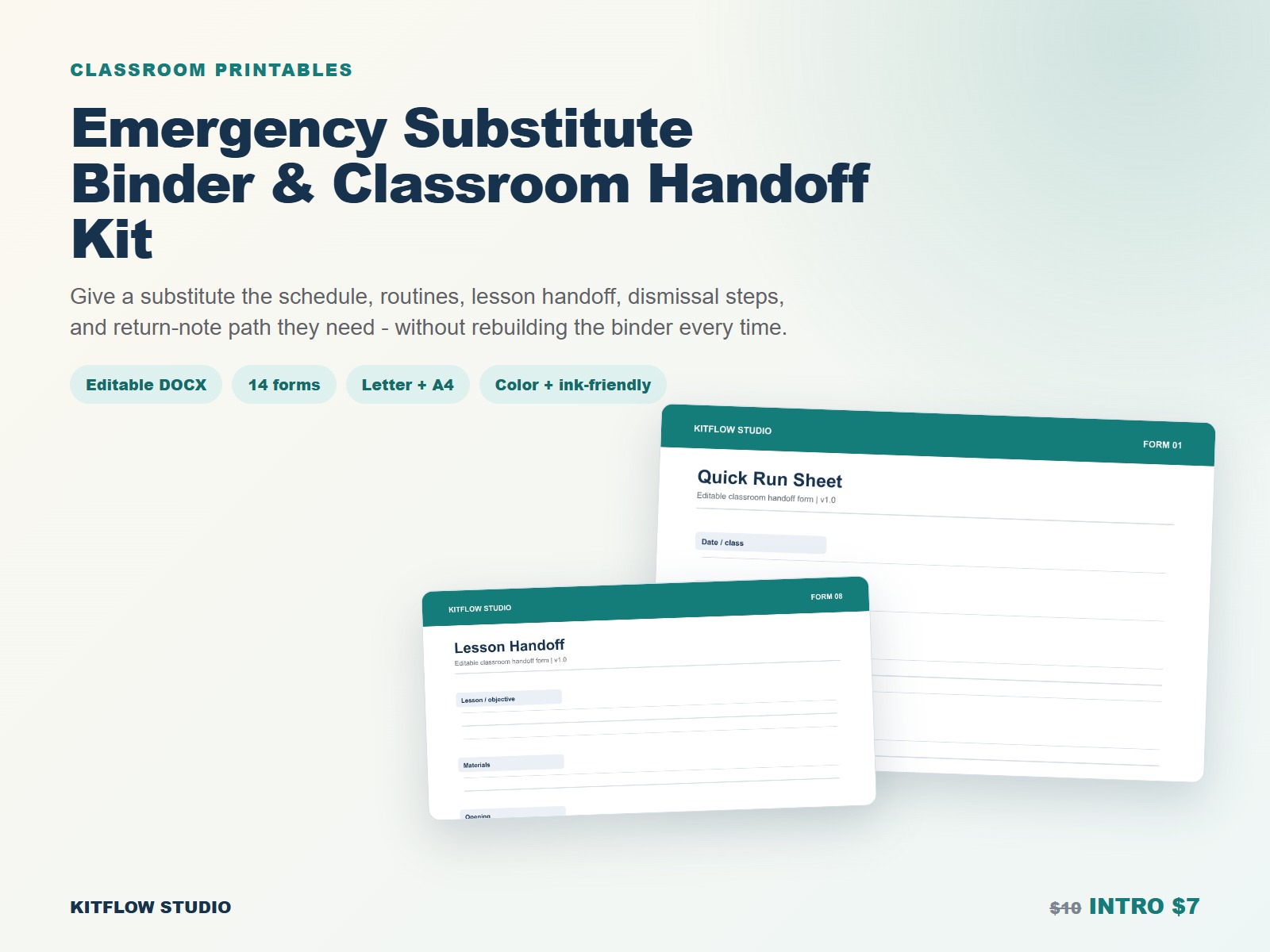
The Emergency Substitute Binder & Classroom Handoff Kit supplies editable and printable handoff pages. Pair it with locally approved lessons; the template is not district policy or a curriculum replacement.
Frequently asked questions
How many days should I prepare?
Begin with one reliable day covering every block. Add more only after the first packet has been tested and your school expectations are clear.
Should emergency work be graded?
Tell students and the substitute how it will be used. A completion check or formative review may be more appropriate than a high-stakes grade for an emergency lesson.
Can the substitute use their own activities?
School rules vary. Give a complete approved plan so the substitute does not need to improvise, and identify the school contact for exceptions.
Sources and further reading
Local policy remains authoritative. A public substitute folder and emergency-plans checklist illustrates the operational information schools may require; confirm the requirements for your own district.