Formative Assessment
30 Exit Ticket Questions That Lead to a Teaching Decision
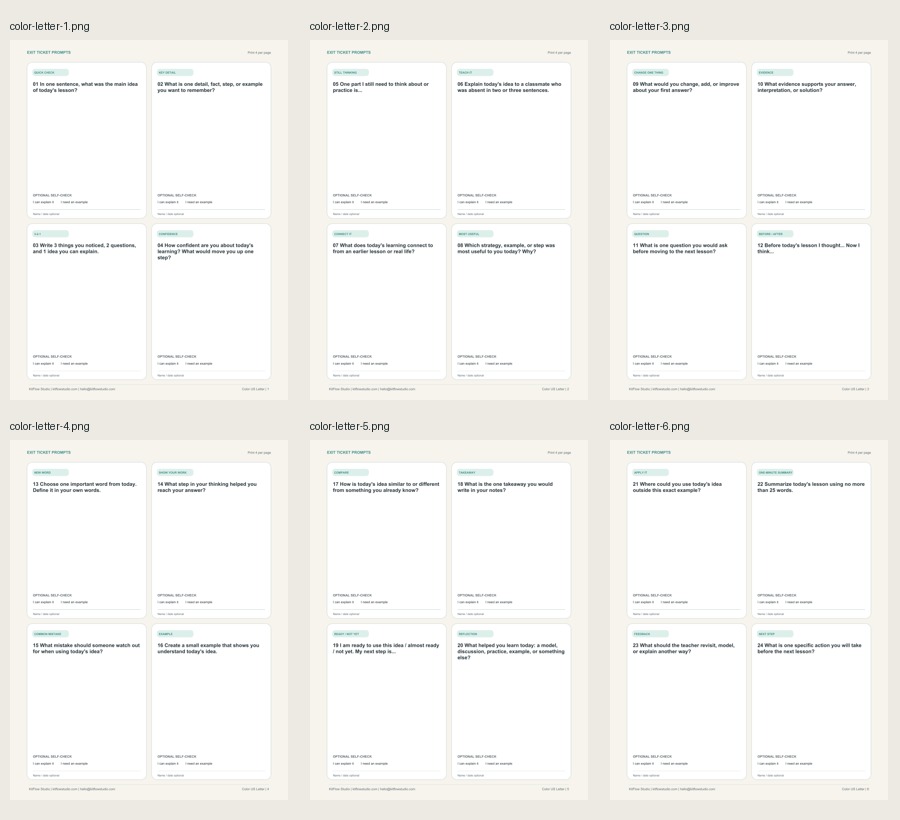
Thirty exit-ticket questions organized by what a teacher needs to decide next—not by decorative format or novelty.
The useful rule
Write the exit question after deciding what you will do with the answers. If every possible response leads to the same next lesson, the prompt is probably reflection rather than formative evidence. Reflection is useful—but name the job correctly.
Choose the decision first
| You need to decide… | Ask for… | Look for… |
|---|---|---|
| Whether to reteach | One direct example or explanation | A repeated misconception |
| Who needs support | A brief attempt plus confidence | Mismatch between answer and confidence |
| Whether students can transfer | A new situation | Correct reasoning beyond the practiced example |
| How to open tomorrow | Most useful question or confusing step | A cluster worth addressing together |
30 questions by purpose
Check essential understanding
- Explain today’s main idea in one sentence.
- Give one example that fits today’s concept.
- Give one non-example and explain why it does not fit.
- What is the first step in solving this kind of problem?
- Which two details are necessary to support the claim?
- Draw or label the relationship between the two key ideas.
Find misconceptions
- What is a mistake someone might make here?
- Correct this statement: [insert a plausible misconception].
- Which step in this worked example is incorrect, and why?
- What did you believe at the start that changed today?
- Which pair of terms is easiest to confuse?
- Write one question that would reveal whether someone understands the idea.
Test transfer
- Where might this idea appear outside today’s example?
- Use the method with this new number, text, source, or scenario.
- Which part of today’s learning would still apply if one condition changed?
- Choose a different strategy and explain whether it would work.
- Connect today’s idea to something learned earlier.
- What evidence would make you revise your answer?
Check confidence without confusing it with mastery
- How confident are you: not yet, partly, mostly, or ready to explain?
- Which step can you complete without help?
- Where would one example help most?
- What could you explain to a classmate now?
- Which resource would you use if you became stuck?
- What part needs another practice round?
Plan the next lesson
- What should we revisit first tomorrow?
- What is one question you still have?
- Which example should we compare next?
- What was the clearest moment in today’s lesson?
- What instruction or word made the task harder to understand?
- What is one short practice task that would help you next?
Turn responses into a five-minute sort
Use three piles or marks: ready to move on, needs a small clarification, and needs reteaching or individual follow-up. Then scan for one misconception shared by several students. The goal is not to score every sentence; it is to choose tomorrow’s opening and identify students who need a different route.
Do not infer mastery from confidence alone. A confident wrong answer and an accurate low-confidence answer call for different follow-up.
Write prompts students can answer in the time available
Use one or two questions most days. Include the expected response shape: one sentence, one example, one labeled sketch, or one calculation. If a prompt requires a paragraph, students may be reporting writing speed more than understanding.
The Exit Ticket Classroom Routine System provides printable formats for several response types. The companion guide How to Choose an Exit Ticket Routine covers timing, collection, and format decisions.
Frequently asked questions
Should exit tickets be graded?
For a quick formative check, completion or no grade often preserves honest responses. Follow school policy and explain how the information will be used.
Can the same question be reused?
Yes. Repeated structures reduce instruction time and make changes in student thinking easier to compare.
What if students write “I don’t know”?
Offer a second prompt such as “Which word, step, or example should we revisit?” That turns a blank endpoint into actionable information.
Sources and further reading
See HMH’s exit-ticket examples and the TESCEA formative assessment handbook for broader classroom context.