Digital Product Economics
How to Price a Digital Product Without Guessing
A transparent method for testing price, discounts, variable fees, affiliate share, refund reserve, support cost, and break-even without pretending one formula knows true profit.
The short answer
Start with contribution per order, not a competitor’s price. Estimate the actual selling price after discounts, subtract percentage and fixed payment fees, platform or affiliate share, refund reserve, and support or delivery cost. Then test how many positive-contribution orders are needed to recover fixed creation and marketing cost.
Use a transparent contribution formula
Net sale price = list price × (1 − discount rate)
Contribution per order = net sale price − percentage fees − fixed fees − platform/affiliate share − refund reserve − support and delivery cost per order
Keep taxes separate unless you have verified whether displayed prices include tax and whether the platform collects or remits it. Do not label contribution as accounting profit: it still needs to recover fixed costs, overhead, owner time not included elsewhere, and applicable tax.
Worked fictional example
Assume a $20 list price and a 10% launch discount. The actual sale price is $18. This example uses simplified assumptions for explanation, not a quote from any payment provider.
| Item | Calculation | Amount |
|---|---|---|
| Sale price | $20 × 90% | $18.00 |
| Percentage payment fee | $18 × 3% | −$0.54 |
| Fixed payment fee | assumption | −$0.30 |
| Platform share | $18 × 5% | −$0.90 |
| Refund reserve | $18 × 4% | −$0.72 |
| Support cost | estimated per order | −$0.50 |
| Contribution per order | $18 − $2.96 | $15.04 |
The reserve is a planning allowance, not proof that refunds will equal 4%. Replace every assumption with data from your platform, processor, and own order history when available.
Estimate break-even without creating false precision
If fixed product cost is $300 and contribution per order is $15.04, the simple break-even estimate is:
$300 ÷ $15.04 = 19.95, rounded up to 20 positive-contribution orders.
Fixed cost might include contracted design, research, licensed assets, testing, and a chosen amount of creator time. Paid advertising should be modeled carefully: you can treat a fixed test budget as fixed cost, or treat expected acquisition cost as variable cost, but do not count the same expense twice.
Break-even orders are not a sales forecast. They tell you what must happen under the assumptions, not whether demand exists.
Run four stress tests before choosing a price
- Discount stress: compare full price, normal promotion, and deepest planned discount.
- Fee stress: use the highest plausible channel fee, including affiliate or marketplace share.
- Refund/support stress: increase both when a product needs setup help or has compatibility risk.
- Volume stress: compare realistic low, base, and high order counts; do not use the high case to justify an otherwise weak offer.
Also compare bundles and licenses by scenario. A higher-priced commercial license may add support or usage complexity; it is not pure margin by default.
Use the model to make a decision, then validate demand
- Reject a price if routine discounts create near-zero or negative contribution.
- Simplify the product if support cost consumes the intended margin.
- Raise or narrow an affiliate rate if the channel case is unsustainable.
- Test value messaging and conversion rather than assuming a lower price fixes weak demand.
- Review the model after real sales, refunds, support time, and fees arrive.
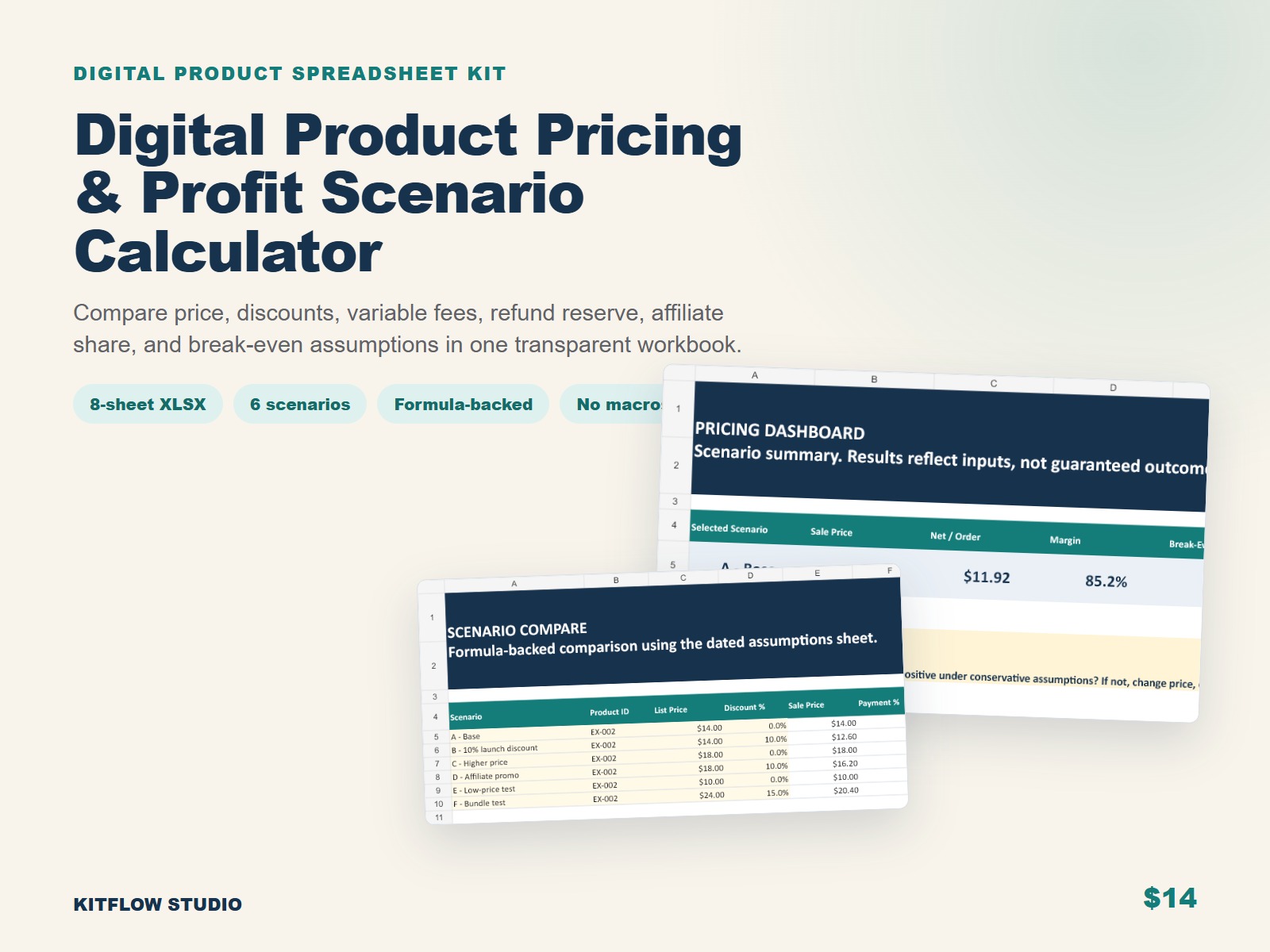
The Digital Product Pricing & Profit Scenario Calculator provides editable scenario inputs and comparison views. It is a planning tool, not financial, accounting, tax, or legal advice; verify current fees and obligations with the relevant providers and professionals.
Frequently asked questions
Should I include my own time?
Yes, if the model is meant to support a sustainable business decision. State whether creator time is a fixed creation cost, ongoing support cost, or both.
How do I price a product with almost zero delivery cost?
Low delivery cost does not remove creation, support, platform, refund, acquisition, or opportunity cost. Price also reflects buyer value and alternatives, which require market validation beyond the spreadsheet.
What if I have no refund history?
Use a clearly labeled planning range, not a single confident number. Replace it as soon as enough relevant order data exists.