How to Set Up a 5-Minute Backyard Spy Treasure Hunt for Kids Ages 7–11
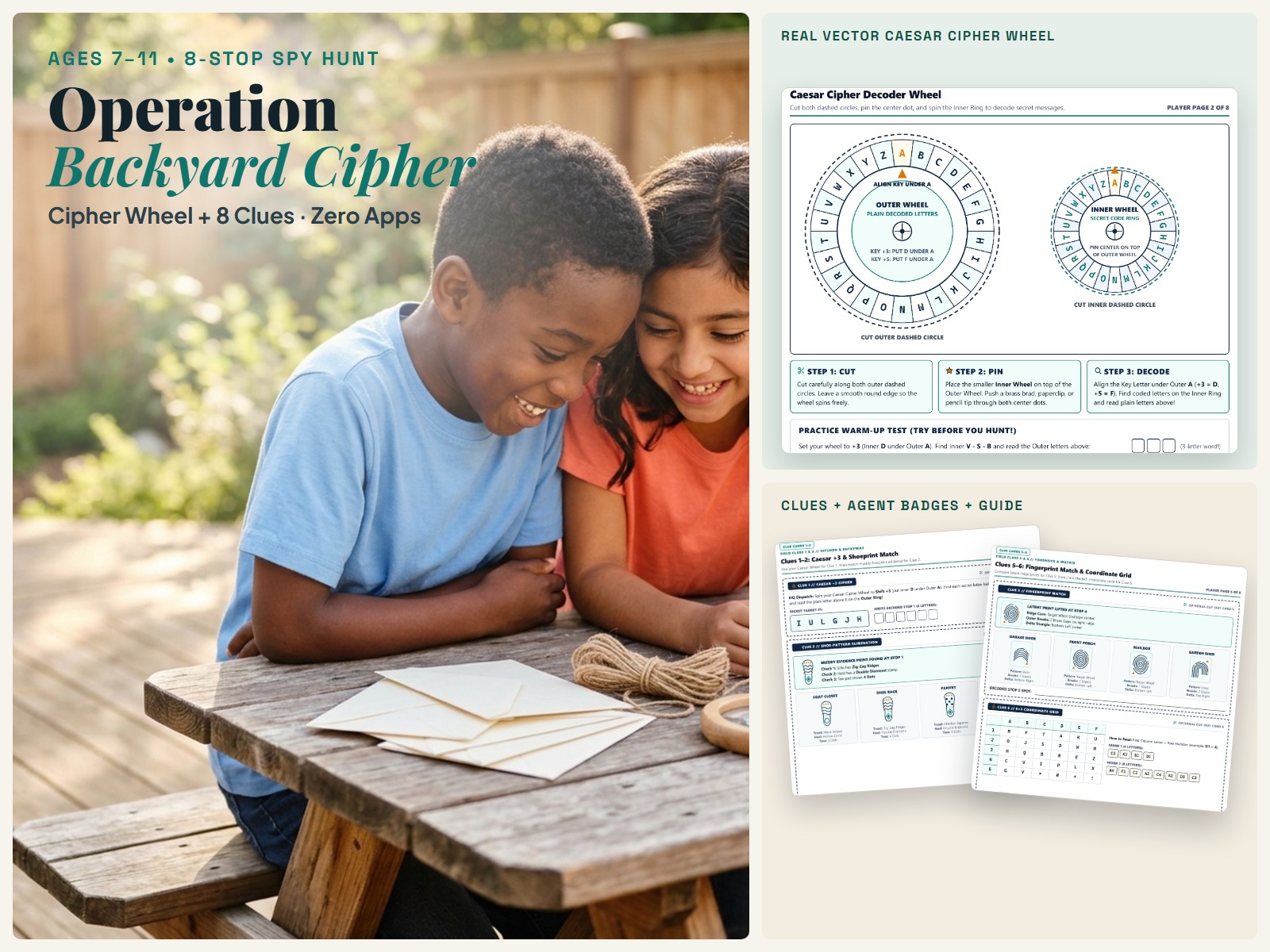
Target Focus Keyword: printable kids spy treasure hunt clues Secondary Keywords: backyard treasure hunt for kids ages 7-11, caesar cipher wheel printable kids, screen free backyard birthday party game, indoor outdoor scavenger hunt clues Featured Product: Operation Backyard Cipher: Kids Secret Agent Treasure Hunt ($8.00 — Instant Digital ZIP)
Planning an unforgettable backyard adventure for kids ages 7 to 11 usually collides with one of two frustrating options: spend two hours writing rhyming riddles on index cards from scratch, or hand everyone a tablet for an app-driven scavenger hunt that defeats the whole point of getting outside.
A printable kids spy treasure hunt solves both problems—when it is engineered for real 7–11 year olds rather than preschoolers or adults. Instead of vague “I keep your food cold” rhymes that kids guess in three seconds flat, real tactile spy tools like a cut-out Caesar cipher wheel, shoeprint tread comparisons, mirror-text clues, and Pigpen symbol decoders turn your everyday kitchen, porch, and backyard into a genuine 30–45 minute secret agent mission.
Here is how to set up a stress-free, 5-minute backyard spy treasure hunt at home—plus how to adapt it instantly for rainy days, solo play, siblings, or a 10-kid birthday party.
Why Rhyming Riddles Fall Flat for Ages 7–11 (and What Works Instead)
Kids between seven and eleven are in a sweet spot: they are past toddler picture hunts, yet still too young for dense adult escape-room spreadsheets. Generic printable hunts fail this age group for three common reasons:
- Instant-Guess Rhymes: “Check where your shoes wait in a row” takes four seconds to read and zero brainpower to solve. Kids sprint from spot to spot in five minutes flat and immediately ask, “What do we do now?”
- One Fast Reader Steals the Show: If every clue is a paragraph of text, the oldest or fastest reader solves all eight clues while younger siblings just trail behind.
- Thirty Minutes of Fiddly Craft Prep: Origami clue boxes and 40 tiny cutout tokens force parents to prep with scissors for half an hour before anyone can even play.
When you swap rhyming riddles for varied visual and code-breaking mechanics, every single stop feels different—and every kid finds a tool they shine at:
- Spinning a Physical Cipher Wheel: Turning two concentric letter rings to align
+3(DunderA) or+5(FunderA) makes cryptography click in ten seconds for an eight-year-old. - Forensic Pattern Matching: Comparing muddy shoeprint treads or concentric fingerprint ridges lets visual thinkers lead without needing fast reading speed.
- Mirror-Lens & Pigpen Decoding: Holding a backwards message up to a bathroom mirror—or matching dot-and-box Pigpen shapes—delivers pure secret-agent delight.
- Coordinate Matrix Decoding: Cross-referencing Column Letters and Row Numbers (
C2,A2,B1,D1) builds stealthy spatial logic skills disguised as a game.
The 5-Minute Parent Setup Checklist
In Operation Backyard Cipher, the 8-page Player Packet and 4-page Parent/Host Setup Guide are structured so you can go from download to launch in five minutes flat:
- Print Only What You Need: Choose US Letter or A4 to match your printer tray. Want to save colored ink before a birthday party? Pick the dedicated 0%-Color Eco-Ink Monochrome PDF—every cipher wheel, fingerprint card, and Pigpen chart prints crisp on plain white paper.
- Cut & Pin the Caesar Cipher Wheel (90 Seconds): Cut along the two dashed circles on Page 2 (
Outer Plain RingandInner Secret Ring). Fasten the center dots with a brass brad, a bent paperclip, or simply have your child press a sharp pencil tip through the center dot to spin the inner wheel. - Choose Cut-and-Hide vs. Zero-Cut Clipboard Mode: – Classic Cut-and-Hide: Snip the eight dashed Clue Cards on Pages 3–6 and hide Clues 2–8 along your 8-stop trail (
Fridge -> Shoe Rack -> Bookshelf -> Sink -> Front Porch -> Sofa Cushions -> Garden Tree -> Prize Stash). Hand kids Clue 1 with their mission briefing. – Zero-Cut Clipboard Mode: Short on time? Skip cutting Clue Cards completely! Put the Player Pages on a clipboard and let kids unlock each next page only after showing you the previous stop’s decoded answer. - Stage Your Mirror & Prize Stash: Leave a small pocket mirror on the table (or remind kids a bathroom mirror or sunny glass window works just as well for Clue 3), and tuck a small prize bag—glowsticks, stickers, juice boxes, or backyard chalk—at the final Prize Stash spot.
- Keep the Host Guide Private: Keep Host Pages 1–4 folded in your pocket or open on your phone so kids never catch a peek at the hiding map.
How to Run a Rainy-Day Indoor Swap in 30 Seconds
Nothing stalls a weekend party faster than sudden rain after you already printed an outdoor treasure hunt. The trick is choosing universal indoor-outdoor anchor spots that swap cleanly without reprinting a single page:
- Front Porch Clue → Inside Front Door Glass: Tape the card on the dry interior side of your front door or entryway window sill.
- Garden Tree Clue → Indoor Houseplant or Patio Slider: Tuck the card behind a potted living-room plant or beside the sliding glass backyard door.
- Prize Stash → Kitchen Island Cooler or Hall Closet Vault: Keep the final prize box locked inside a zippered picnic bag or held by you (“Headquarters”) until kids shout the 3-part Vault Code.
Announce one quick rule before kickoff—“Any outdoor clue today hides just inside that doorway!”—and the entire 8-stop mission runs smoothly indoors in socks.
Balancing Mixed Ages (1 Kid, Siblings, or a 10-Kid Birthday Party)
Whether you are entertaining one bored child on a school break or running a chaotic Saturday birthday party, small facilitation tweaks keep everyone involved:
- Solo Agent (1 Kid): Let your child fill out an official Secret Agent ID Badge (Page 7) with their own codename before starting. If they hit a snag for more than two minutes, use a tool nudge rather than spoiling the spot—for example, “Double-check that Inner D is lined up directly under Outer A!”
- Siblings (2–4 Kids): Assign rotating field jobs every two checkpoints: Wheel Master, Forensic Checker, Mirror & Grid Scout, and Mission Scribe. Rotating roles stops an older sibling from solving every puzzle solo.
- Birthday Party (5–10 Kids): Avoid sending ten kids stampeding toward one paper card. Split into two 4–5 kid squads (Team Teal and Team Gold), print two copies of Clues 2–8 inside color-coded folders at each stop, or stagger Team Gold three minutes behind Team Teal so both squads solve every puzzle fairly.
Give Every Kid a Tangible Finish (Not Just a Sugar Rush)
The best part of a spy treasure hunt happens right after the final Vault Lock Box opens. Rather than letting the excitement evaporate once snack bags come out, spend two minutes signing each child’s Secret Agent Completion Certificate (Page 8, printed 2-up with clean fill-in lines for their name, secret codename, and date). Kids ages 7–11 take immense pride in holding up their signed certificate and custom Agent ID Badge after cracking real codes themselves.
Ready to Print and Play in 5 Minutes?
If you want a ready-to-run, mathematically verified printable kids spy treasure hunt packed with a real cut-out Caesar Cipher Wheel, Shoeprint & Fingerprint Forensics, Mirror-Text Lens, Pigpen Key, 6×5 Coordinate Matrix, Agent ID Badges, Completion Certificates, and a 4-Page Parent/Host Setup Guide, grab Operation Backyard Cipher: Kids Secret Agent Treasure Hunt ($8.00 — Instant US Letter & A4 Color + Eco-Ink Digital ZIP).