Best Printable Roll-and-Write Board Games: Why Coastal Drafting Works for Solo & Family Nights
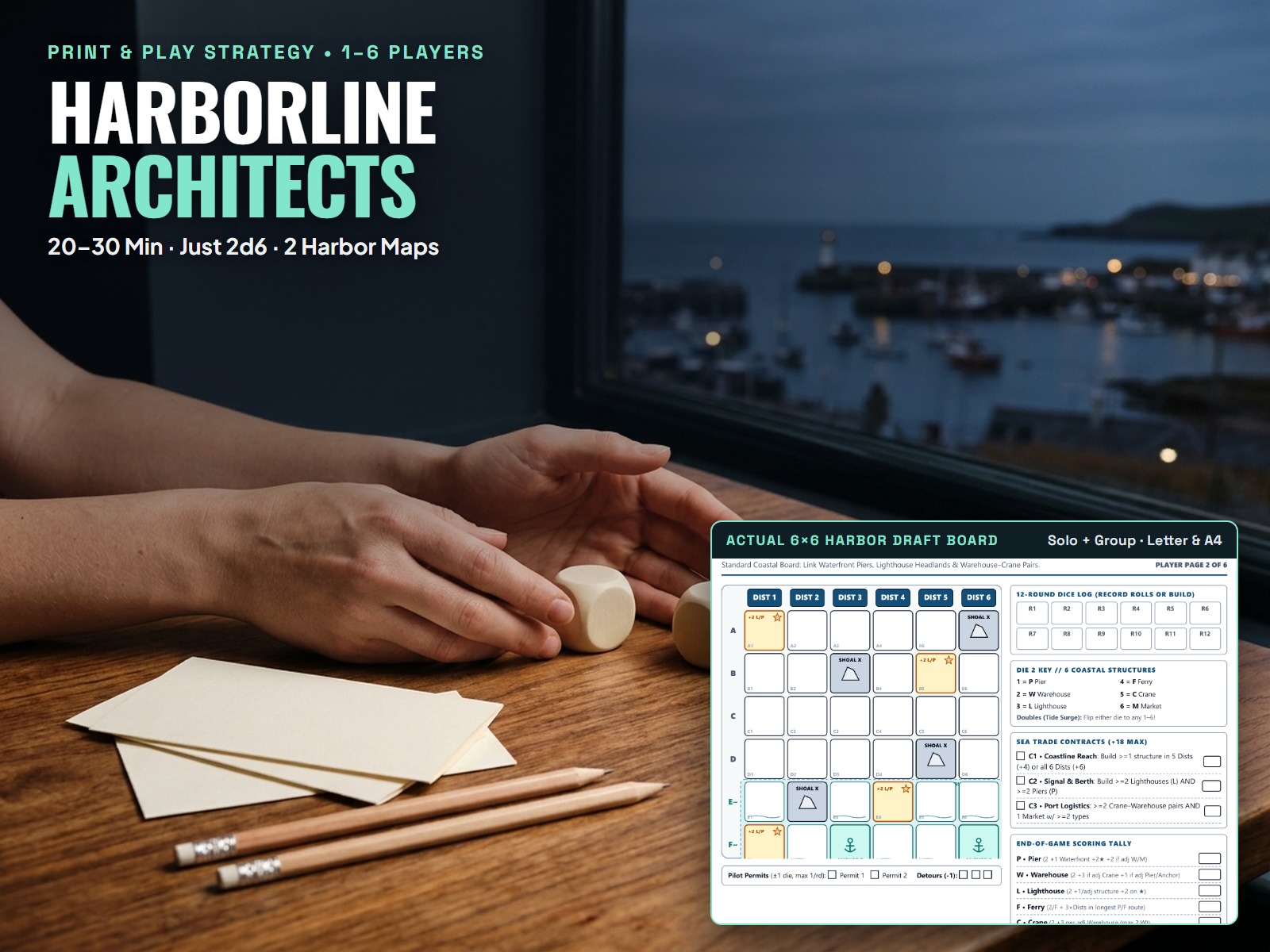
Target Focus Keyword: printable roll and write board game pdf Secondary Keywords: roll and write printable board game, solo printable strategy game, 2d6 print and play game, family game night roll and write pdf Featured Product: Harborline Architects: Printable Roll-and-Write Strategy Game ($6.00 — Instant Digital ZIP)
If you love Euro-style tabletop strategy—building interconnected harbors, chaining trade routes, and squeezing maximum synergy out of a single turn—you have probably noticed a frustrating gap in printable games. Most free or cheap print-and-play downloads fall into one of two extremes: either they are five-minute luck fests where you cross off random boxes, or they require sixty cards, three hours of scissors work, and a twelve-page rulebook before anyone rolls a die.
That is why the printable roll and write board game PDF has quietly become one of the smartest formats in modern tabletop gaming. With a single printed sheet, a pencil, and two ordinary six-sided dice (2d6), you get real spatial puzzle tension, zero setup clutter, and simultaneous turns where nobody waits five minutes for another player to finish their turn.
Even better, a coastal harbor-drafting theme turns a simple 6×6 grid into an instantly readable world. Below is a closer look at why roll-and-write games work so effortlessly for both solo coffee-break sessions and lively 6-player family nights—and what mechanical ingredients separate a truly replayable strategy sheet from disposable filler.
What Makes a Roll-and-Write Game Feel Like a Real Euro Board Game?
At first glance, rolling two dice and writing letters on a grid looks deceptively minimal. Yet the best roll-and-write designs—from classic rail-network sketchers to modern harbor builders—deliver genuine strategic depth by giving players three layered tensions every single turn:
- Dice Allocation Instead of Pure Luck: In a great roll-and-write, you are never stuck passively accepting a single outcome. When
2d6is rolled, you choose which die sets your District Zone (1–6) and which die sets your Coastal Structure (1–6). Rolling a3and a5can mean a Lighthouse (3) in District 5, or a Crane (5) in District 3. That single two-way pivot doubles your tactical space every round without adding any rules bloat. - Simultaneous Shared-Pool Drafting (Zero Downtime): Whether you are playing solo at a quiet kitchen table or hosting six players on a Friday night, everyone uses the same shared 2d6 roll each round. Every player secretly or simultaneously sketches their own harbor layout on their own sheet. A 6-player match takes the exact same 20–30 minutes as a 1-player solo run—meaning nobody checks their phone waiting for a slow turn.
- Spatial Synergy Over Isolated Points: Flat score-sheets reward spamming whichever symbol pays the most points. Strategy-first harbor drafting rewards adjacency, pairing, and network routing. A
Warehousesitting alone in an inland square is underwhelming—until you place aCraneright next to it and link aPieralong the shoreline. AMarketbarely scores next to duplicates, so you weavePiers,Warehouses,Lighthouses,Ferries, andCranesaround it to unlock diversity multipliers.
Why Coastal Harbor Drafting Works So Well on Paper
Not every theme translates cleanly to a pencil-and-paper grid. Fantasy dungeon crawls often demand monster HP tracking and fiddly line-of-sight rules, while heavy sci-fi tech trees turn into tiny spreadsheets.
A coastal city and harbor map, by contrast, is visual shorthand everyone understands in ten seconds:
- Natural Terrain Constraints: Pre-printed Shoal Rocks block careless straight-line builds, Headland Beacon Stars tempt you toward risky edge tiles, and Anchor Piers invite you to string Ferry Routes across open bays and shipping channels.
- Readable Six-Symbol Icons: Instead of cluttering the sheet with tiny paragraphs, coastal infrastructure compresses cleanly into six intuitive icons and letters—Pier (
P), Warehouse (W), Lighthouse (L), Ferry (F), Crane (C), and Market (M)—that stay sharp even on a fast black-and-white laser print. - Two Distinct Ways to Play (
Seaglass Covevs.Split Archipelago): Changing the coastline geometry immediately transforms your drafting priorities. On a sweeping single cove, players race to link shoreline Piers and inland Markets; on a twin-island archipelago split by a shipping channel, bridging North and South islands with connected Ferry routes becomes the defining mid-game gamble.
Inside Harborline Architects: 12 Rounds, 6 Structures, 2 Maps
If you are looking for a ready-to-print tabletop strategy kit built around these exact Euro mechanics, Harborline Architects: Printable Roll-and-Write Strategy Game ($6.00) packages a complete 12-round coastal drafting experience into a 1-minute prep instant digital download.
How a 12-Round Match Flows
- Roll
2d6(or Spin the Included Paper Dice): One player rolls two standard six-sided dice. Don’t have physical dice in your travel bag or hotel room? Player Page 6 includes both a pencil-and-paperclip Paper Dice Spinner and a Foldable Paper Dice Reference Sheet so you can play anywhere with just a pen. - Choose Zone vs. Structure: Assign one die to District Column
1–6and the other to one of six structures (1 = Pier,2 = Warehouse,3 = Lighthouse,4 = Ferry,5 = Crane,6 = Market). - Trigger Tide Surges & Pilot Permits: Roll doubles (
d1 == d2)? Tide Surge lets you flip either die to any value1–6! Need to salvage a tight build in Round 10? Spend one of your 2 Pilot Permits per game to nudge any die by±1. - Chase Sea Trade Contracts & Harbor Networks: Across 12 quick rounds, balance immediate adjacency points against three Sea Trade Contracts—spanning all six districts (
Coastline Reach), pairing beacons with docks (Signal & Berth), and linking Cargo Cranes to bustling Markets (Port Logistics).
Balanced Scoring & Solo Harborwright Rank Tiers
Unlike untested print-and-play drafts where one dominant trick breaks the scoreboard, Harborline Architects was stress-tested across thousands of simulated 12-round games so every structure carries real weight. Random legal placement averages around 40–45 points, whereas thoughtful route planning and Pilot Permit timing routinely pushes scores into the 70–85+ point range.
That clear skill gap anchors the 5 Solo Harborwright Rank Tiers printed right on the sheet and tracked in the 3-Game Solo Campaign Ledger:
- Under 45 pts: Dockhand
- 45–59 pts: Mate
- 60–74 pts: Navigator
- 75–89 pts: Portmaster
- 90+ pts: Master Harborwright
Designed for Real Kitchen Tables & Travel Bags (Full Color + Eco-Ink + 2-Up Sheets)
A great printable roll and write board game PDF should respect your printer ink and paper stack as much as your time at the table:
- Full-Page & 2-Up Half-Page Sheets: Both **Map A (Seaglass Cove) and Map B (Split Archipelago) come as full-page sheets (great for solo focus or older eyes) AND 2-Up Half-Page Sheets** so a 4–6 player family night prints twice as many game boards on half the paper.
- True 0%-Color Eco-Ink Edition: Alongside the maritime cobalt, seafoam, and terracotta Color Edition, the bundle includes a dedicated Eco-Ink Monochrome Edition with pure
#FFFFFFbackgrounds and distinct crisp icons (P / W / L / F / C / M), engineered for crisp home B&W laser and inkjet printing. - US Letter & International A4 Included: Print cleanly in North America (
8.5 × 11 in) or Europe/UK/Australia (A4) with printer-safe margins—zero edge clipping. - Separate 3-Page Rules & Strategy Reference: Players get a clean 6-Page Player Pack (Cover + Visual How-to-Play, Maps A & B in Full + 2-Up, Paper Spinner & Solo Ledger), while the 3-Page Host Rules & Strategy Reference covers edge-case rulings, worked scoring breakdowns, and solo challenge achievements.
Tips for Your First Tabletop or Solo Session
- **Start on Seaglass Cove (Map A):** Play your first 20-minute round on the classic cove to get a feel for
Warehouse + Cranecargo pairs andMarketdiversity before tackling the twin-island channel crossing on Split Archipelago. - Save at Least One Pilot Permit for Rounds 9–12: Early rounds give you wide-open columns; late rounds are when a single
±1die nudge turns a4-District Ferry Routeinto a6-Districtsweep or locks your final Trade Contract. - Laminate Two Copies for Endless Travel Play: Slip two half-page boards into dry-erase sleeves (or page protectors) and keep a stubby pencil or fine-tip dry-erase marker in your carry-on—you have a 20-minute Euro strategy game ready for airports, coffee shops, and cabin weekends.
Ready to draft your first coastline? Download Harborline Architects ($6.00) and print your first sheet in under a minute.