Last Stop: Parcel Desk contains six fixed station-ledger logic cases. In each case, four people each collect one parcel for one destination on one of four departures. Your job is to reconstruct the entire ledger from the printed clues. You can work alone, or two people can discuss one shared sheet.
The game uses fictional station details, not real train knowledge. Every clue is true, and every name, parcel, destination and departure is used exactly once. Each case starts fresh. An assignment learned in one case tells you nothing about the next case.
Prepare the player sheet and keep the answer separate
Choose US Letter or A4 to match your printer paper. Print portrait, single-sided, at Actual Size or 100%. The player PDF has seven pages: one rules page and six one-page cases. Print the rules and whichever cases you want to try. Pencils and spare paper are sufficient; no scissors, locks, timer, app or lookup are part of the game.
The separate six-page Host PDF has one page per case. It includes two optional hints, a complete ledger and a clue-by-clue answer check. A solo player can use that reference without another person hosting. Keep it closed or face down while solving, and reveal only the current case when you choose to use help. Seeing an answer early cannot be undone by restarting the same fixed case.
Establish what a departure means
Departure 1 is earliest and departure 4 is latest. The clues distinguish "earlier than" from "immediately before." Earlier can be one, two or three positions earlier. Immediately before means exactly one departure earlier.
For a generic example outside the actual cases, suppose a scarf parcel leaves earlier than a basket parcel. The scarf cannot be on departure 4, and the basket cannot be on departure 1. That clue alone does not require adjacent departures. If the wording instead says immediately before, the departures must be consecutive. Neither example is a clue or an answer from the supplied cases.
Do not add a real-world timetable or assume a parcel's name implies a destination. The written clues and the one-of-each rule supply the whole task.
Track three linked assignments
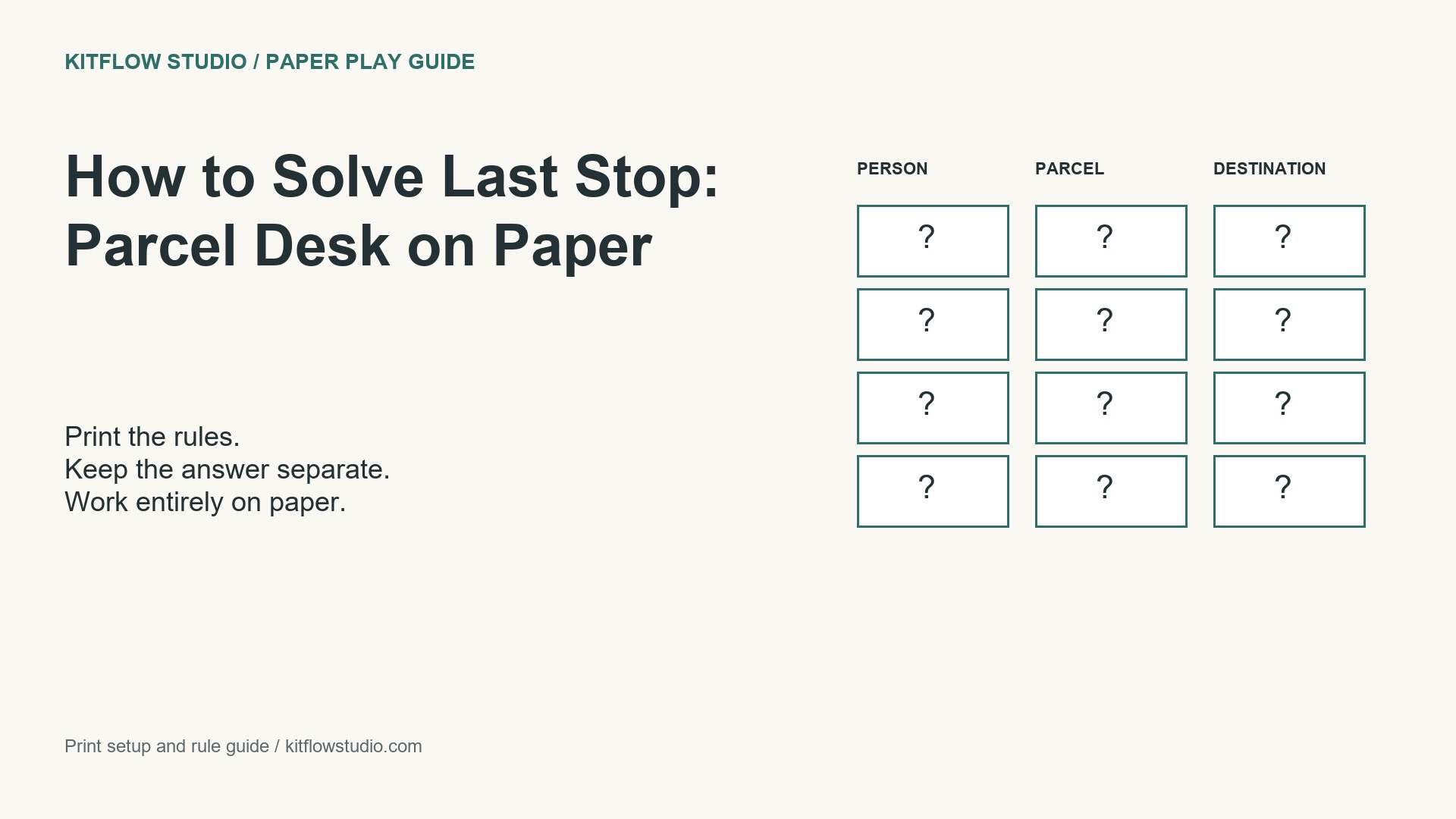
Each case sheet provides a blank ledger and three small grids. Grid rows are departures 1-4. Column labels are people in the first grid, parcels in the second and destinations in the third.
Use an X for an impossible pairing and a dot for an established pairing. Each finished grid has one dot in every row and every column. When you establish a person's departure, rule out that person on other departures. When a clue links that person to a parcel, carry the information into the parcel grid instead of treating each grid as a separate puzzle.
This linking is the main job. A finished answer is not just an ordering of names: every departure row needs a person, parcel and destination. Leave uncertain ledger cells blank until a clue or chain of deductions supports them. Guessing a plausible station story is not evidence.
Work from a restriction to a connection
Start by recording clues that connect two things to the same departure, or restrict an item to a place before or after another item. Edge departures can help: an item immediately before something else cannot be last, and the later item cannot be first.
Then combine connections. A person-parcel link and parcel-destination link refer to the same ledger row if all three share a departure. Use spare space for a note explaining why an entry follows. If you try a possibility while stuck, label it as a trial and return to the last established fact if it contradicts a clue.
Digital checks find one complete ledger satisfying all printed clues in each case. That uniqueness check does not measure human difficulty or promise a particular solving technique for every reader.
Use a hint, then verify the whole ledger
The first hint highlights a starting relationship and how to record it. The second supplies one confirmed assignment. Choose whether to use either hint; no penalty is required. If solving with a partner, agree before revealing it so one person does not remove the other's chance to reason.
When the ledger is full, check every clue before opening the answer. A row that looks reasonable may still violate an immediately-before relation. After revealing the answer, use the host page's numbered checks to locate a mismatch rather than merely comparing the final names.
Understand the difference from a card-ordering puzzle
KitFlow's Six Plans Together is a related fixed-clue product. It asks a small group to arrange six cut-apart activity cards in a row across three rounds. Last Stop instead asks for three linked one-of-each assignments across four ledger rows, with six independent cases and a solo pencil-and-paper workflow.
Those are observable task and preparation differences, not proof that every Six Plans buyer needs another product. Both belong to fixed open-clue constraint reasoning, and both lose discovery once their solutions are known. Choose based on wanting to fill and cross-check a multi-attribute ledger rather than move an activity-card row; do not choose merely because the story is set in a station.
Set honest expectations
The suggested age is 12+, with English reading and simple ordering required. The time allowance is unmeasured. Human playtests, physical printing and age suitability testing have not been performed. There is no learning, clinical or accessibility certification claim.
The static download contains four PDFs for A4 and Letter player/host materials, plus Start Here and a license. It contains no editable production code. For file questions, use Contact; browse other activities in the shop. Read the supplied license and current fit notes before buying.
Get Last Stop: Parcel Desk: the complete printable game. Review the product page for contents, print quantities and current fit notes.