Sprint Retrospective Games for Software Engineers: How to Run a Non-Cringe Team Activity
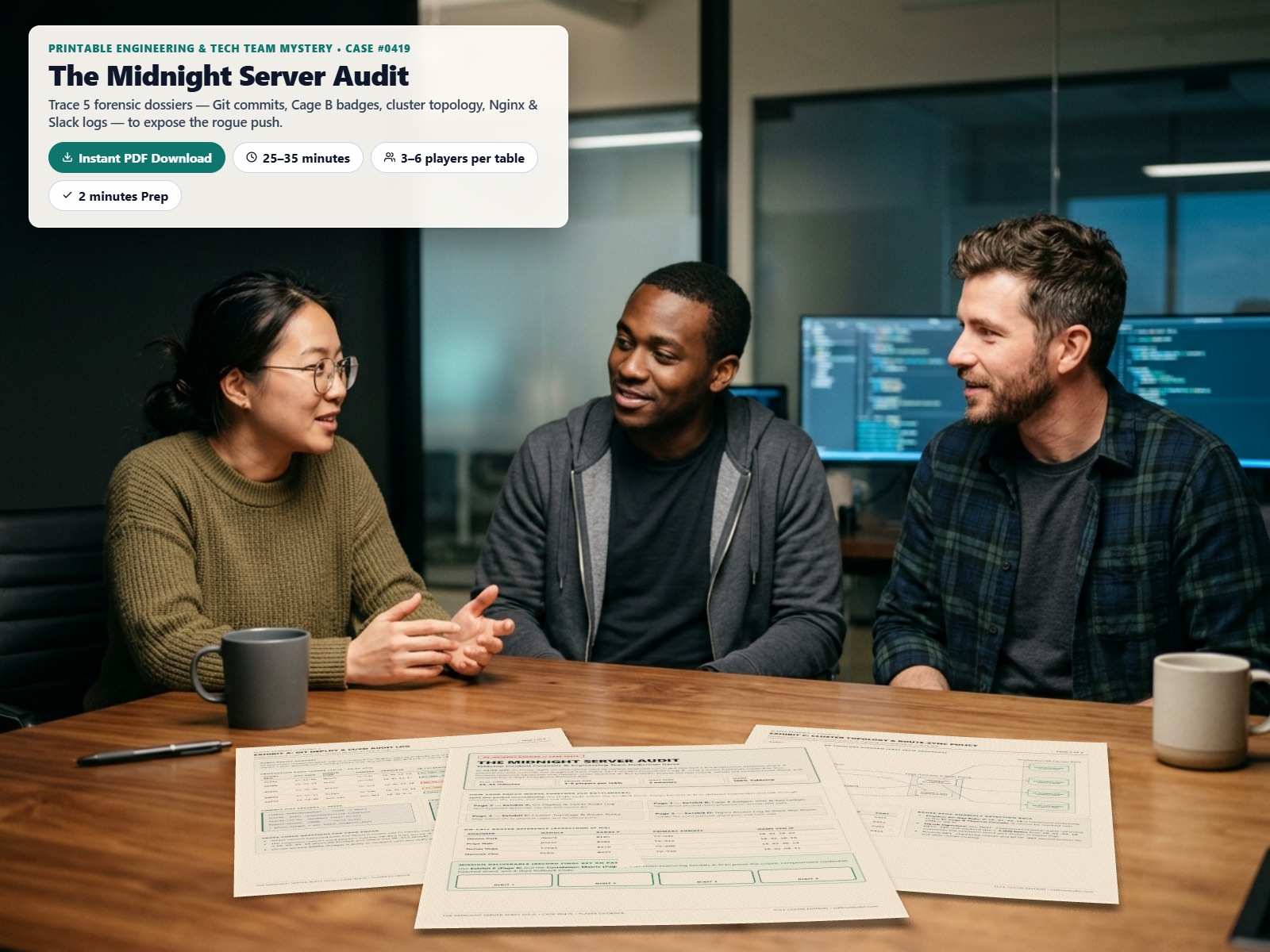
Mention “team building” in an engineering Slack channel and you can practically hear the collective sigh. Developers, SREs, and product engineers spend their days debugging race conditions, untangling distributed logs, and reasoning through complex edge cases. Asking them to spend 45 minutes on forced “two truths and a lie” prompts or middle-school party trivia feels patronizing—and rarely creates real connection.
Yet engineering managers, Scrum Masters, and tech leads still face a real challenge: remote and hybrid squads rarely get low-stakes time to think together outside urgent tickets, sprint deadlines, or live production fires.
The solution is to match the activity to how analytical teams actually enjoy thinking: structured, evidence-based tabletop deduction where teammates split real-looking artifacts, spot contradictions, and solve a mystery together in 25–35 minutes.
Quick answer: what makes an engineering team game work?
| Design factor | Why generic icebreakers fail | What works for analytical squads |
|---|---|---|
| Cognitive respect | Forced personal sharing, acting, or pop-culture trivia | Timestamps, log correlation, system topology, and pure logic |
| Table participation | One loud voice dominates—or one reader solves a single sheet alone | Asymmetric evidence packets require verbal cross-checking |
| Setup overhead | 40 minutes of cutting clues, taping envelopes, or installing apps | Zero-prep tabletop PDF: print 1 packet per table and start in 2 minutes |
| Cross-team fit | Excludes introverts or hinges on obscure coding trivia | Zero code writing required—PMs, QA, Designers, and devs play equally |
| Post-game tone | Managers turn the debrief into a veiled performance critique | Clean resolution script + optional blameless retro prompts |
Why traditional sprint retrospective games trigger “corporate cringe”
Across engineering communities and agile retrospectives, the same three failures appear whenever a team activity flops:
- The “One Person Solves, Five People Stare” Bottleneck: Standard printable puzzles put every clue on one linear page. One fast puzzle solver grabs the sheet while everyone else checks their phone.
- Weaponized Debriefs: Nothing kills psychological safety faster than a manager quietly grading how teammates communicated during a game and lecturing them afterward.
- Cheesy Formatting: Cartoon clipart, forced puns, and fake error messages break immersion immediately for anyone who reads real terminals every day.
A practical format: the 30-minute tabletop incident triage
One of the highest-engagement formats for engineering offsites, sprint celebrations, and intern cohorts is a simulated incident forensics mystery. A squad of 3–6 teammates acts like an on-call response team triaging a Friday-night production anomaly inside a 40-minute retro block:
- Minutes 0–3 — The 60-second briefing: Hand one 8-page evidence packet to each table of 3–6 people. Have every table divide Exhibits A through D immediately among different players.
- Minutes 3–28 — Parallel cross-examination: No single sheet holds the answer. One person reading the cluster topology has to talk to the teammate holding the Git deploy ledger to connect an IP to a physical server cage, while others check badge windows against Slack alibis.
- Minutes 28–33 — Rollback key verification: Squads synthesize their findings into a 4-digit override code and submit Page 8 quietly to the host.
- Minutes 33–40 — Victory reveal & blameless debrief: Read the 60-second resolution script and pick one light question, such as “Which single detail broke the case open at your table?”
How to prevent the 1-person bottleneck in any tabletop game
- Split information physically: Put network maps, Git commits, and badge records on separate exhibits so four people hold four distinct pieces of truth.
- Avoid coding-syntax trivia: Ground deductions in universal logic—UTC timestamps, IP-to-port routing, duration math, and alibi checks—so PMs, QA, and Designers contribute just as fast as senior SREs.
- Use tiered non-spoiler hints: Keep 3 progressive nudges ready per puzzle pillar so facilitators never blurt out the answer when a table pauses.
Ready-to-print option: The Midnight Server Audit (v2.0)
If you want a turnkey kit you can print in two minutes for your next engineering retro or hackathon social, explore The Midnight Server Audit by KitFlow Studio.
- Duration & group size: 25–35 minutes, 3–6 players per table (2 minutes host prep, unlimited internal org copies).
- 8-Page Player Evidence Dossier: Git deploy ledger, Cage B badge & VPN records, vector cluster topology, authentic Nginx combined logs, Slack war-room transcript, 4×4 Rollback Auth Matrix, correlation matrix, and submission sheet.
- 6-Page Private Host Master Guide: 60-second kickoff script, complete proof chain, 3-tier hint ladder, multi-table leaderboard, and blameless retro prompts.
- Print flexibility: Both US Letter and A4 included, in Full Color and dedicated Eco-Ink Monochrome.
View The Midnight Server Audit Printable Kit
Frequently asked questions
How many people can play at once?
Each packet supports 3–6 teammates around one table. For larger organizations of 12 to 60+ people, print one packet per table and run a friendly multi-squad competition using the included Host leaderboard.
Can non-engineers (PMs, Designers, QA) participate?
Yes. Every clue is solved through timestamp comparison, IP-to-diagram matching, and alibi verification—never by writing code.
Do we need a color printer?
No. Every download includes both a Full-Color edition and a dedicated Eco-Ink Monochrome edition engineered with white backgrounds and text status tags for standard office black-and-white copiers.