A Quiet Cooperative Card Game Night for 2 to 4
Cooperative card games for a quiet small-group night work best when everyone has room to think, not just a chance to move the pieces. For two to four teens or adults sharing a logic puzzle, agree on a simple rhythm: suggest one move, explain the reason, then invite someone else to check it.
You can try that rhythm with the free four-card exercise below. You need four scraps of paper and a clear patch of table. No purchase is needed.
Choose a puzzle that fits the evening
Start by asking whether people want to solve something together. A shared ordering puzzle suits a group interested in reading short conditions, comparing ideas and revising a plan. It may be a poor fit if people want performance, trivia, fast reactions or a competitive winner.
Quiet does not have to mean silent. Allow conversation and time to reread. Put all the clues where everyone can see them, agree which side of the table defines left and right, and leave enough room to move the pieces without covering the text. Start with one puzzle rather than committing to a whole evening.
Share the reasoning before moving the cards
When someone sees a solution quickly, ask them to offer the next useful step rather than announce the entire order. Try: “Which clue makes that position necessary?” A reason gives another player something to inspect; an instruction only gives them something to obey.
- Read first. Let everyone finish reading before the first proposed move. Offer reading help without supplying the answer.
- Suggest one change. Name the card, the proposed position and the clue behind the choice. Ask before rearranging someone else’s suggestion.
- Invite a check. Another person explains whether the change fits their clue. A useful objection counts as participation.
- Leave room to pass. “I need another look” is a valid response. Return to that person later without turning the invitation into a test.
With two people, swap suggesting and checking. With three or four, move the invitation around the table. These are hosting choices, not a guarantee of equal involvement. An open-information puzzle can still be solved by one person; the group has to choose to leave thinking space for others.
Try this free four-card ordering puzzle
Write one name and its condition on each scrap. Place all four in a single row, in any starting order. “Before” and “after” mean somewhere earlier or later; “immediately after” means the next position with no card between.
- Pebble: I am before Birch.
- Birch: I am not at either end.
- Lantern: I am immediately after Birch.
- Ribbon: I am after Lantern.
Each person can read or check a condition. With two people, take two each. Keep all four visible. Before moving anything, ask: “Which positions could Birch occupy?” This exercise was created for this article; it is not a round or answer from Six Plans Together.
Answer and reasoning
The order is Pebble, Birch, Lantern, Ribbon. Birch cannot be first or fourth. If Birch were third, Lantern would have to be fourth, leaving nowhere after Lantern for Ribbon. Birch therefore belongs second, and Lantern third. Ribbon must be fourth, leaving Pebble first.
Now check all four conditions aloud. Notice that the final check is different from finding the answer. Someone who did not spot the key deduction can still explain why Pebble fits or why Birch cannot move to the end. Invite that explanation without pretending every clue-holder was mathematically indispensable.
Recover when one person takes over
Pause the moving, not the person. Say, “Let’s leave the cards here while everyone checks one condition.” Ask the quickest solver to name a question the group can investigate rather than give the next answer. If an idea fails, identify the condition it breaks instead of judging the person who suggested it.
Agree before starting that a hint, a break or stopping after one round is allowed. If someone already knows the solution, they can help read and check, but should say so. Keeping a remembered answer secret does not restore discovery for them.
Prepare Six Plans Together for three six-card rounds
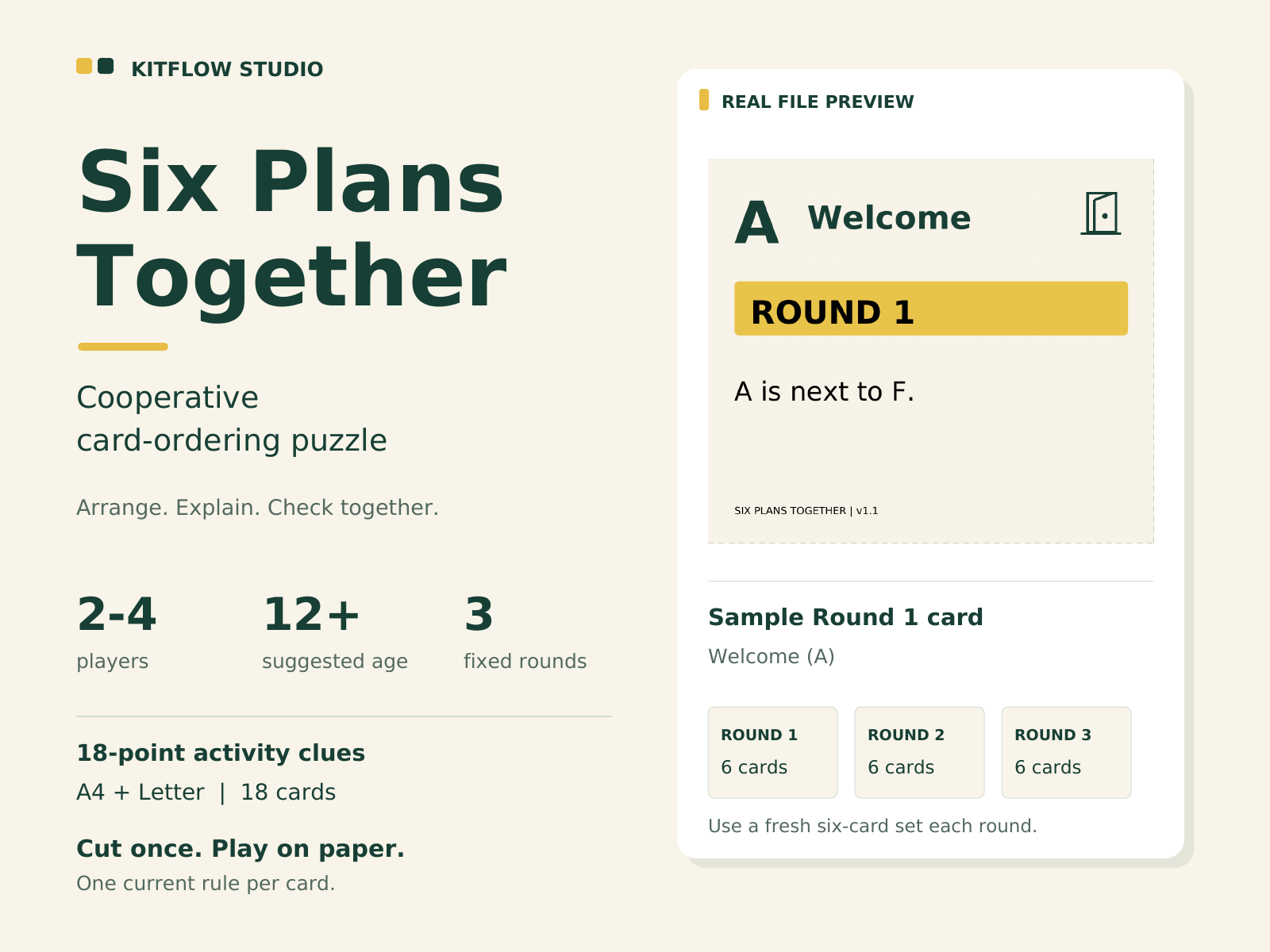
Six Plans Together is KitFlow Studio’s printable version of this kind of shared reasoning. It has three fixed rounds of six cards each, 18 cards total. Its best fit is 2–4 players, with suggested independent reading and reasoning at ages 12+. Five or six can use organizer-guided turns; 7–8 is not recommended.
- Choose A4 or US Letter, then Standard or Low Ink player pages. Choose the matching host size. The formats contain the same game.
- Print portrait, single-sided, at 100% / Actual Size: one player guide, three card sheets and five host pages, nine sheets altogether. Check the print preview for clipping.
- Cut each card sheet into three horizontal strips, then halve each strip: five straight cutting paths per sheet, 15 total. Sort the 18 cards into three six-card round stacks. Do not fold.
- Allow about 70 × 25 cm for the active row, plus side space for guides and spare stacks. Read host page 1; keep the separate hints and answer pages closed.
- Start each round in A–B–C–D–E–F order. Share the clue checks and recheck every condition before accepting a plan.
Scissors are for preparation only. Play needs no app, timer, glue, tokens or pen. The activities named on the cards are imagined, not performed. Play is untimed; fixed answers mean less discovery on repeat play. This edition has not had real-participant playtests or physical printer/cutting tests, and large clue text is not an accessibility certification.
Prefer a pencil puzzle for one person or a pair? See our guide to solving printable route logic puzzles, including a free miniature example.