Facilitator Plan
A 60-Minute Team-Building Session Agenda That Has a Point
A minute-by-minute team-building agenda built around one shared outcome, with host cues, adaptation options, and a useful debrief.
The useful rule
One hour is enough for one meaningful shared experience and one useful conversation. It is not enough for five games, a culture workshop, and a strategy session. Choose a single outcome, protect time for the debrief, and end with one small agreement the team can actually use.
First choose the kind of hour you need
| Outcome | Best activity shape | Debrief question |
|---|---|---|
| Warm up a new group | Pairs plus a low-stakes shared task | What made it easier to contribute? |
| Practice collaboration | Puzzle or constrained build | How did information move? |
| Reset meeting energy | Short movement or observation challenge | What should we carry into the next work block? |
| Improve handoffs | Role-based sequence with incomplete information | Where did ownership become unclear? |
Avoid promising that one activity will “fix trust.” The session can create a useful observation or shared reference point; trust depends on what happens afterward.
The 60-minute agenda
- 0–5 — Arrival and purpose. State why the session exists, what it is not, and how participation works. Give a no-explanation pass option for personal sharing.
- 5–12 — Short opening. Use one work-safe question in pairs. Ask for answers under 45 seconds.
- 12–17 — Explain the challenge. Demonstrate the first move, define the finish condition, and answer rules questions before starting the timer.
- 17–42 — Shared challenge. Run one printable mystery, tabletop escape room, or collaborative task. The host watches participation and provides graduated hints.
- 42–52 — Debrief. Move from observation to meaning: What happened? What helped? Where did the group stall? What resembles our normal work?
- 52–58 — One agreement. Write one behavior the team wants to try, an owner, and where it will be reviewed.
- 58–60 — Close. Thank the group, explain what happens to notes, and end on time.
Host language that reduces awkwardness
“This is a short shared challenge, not a personality test. You can pass on any personal prompt. The goal is to notice how we work together, not to identify a winning type of person.”
During the challenge, do not narrate every silence. If one person takes over, redirect the next clue or role. If instructions are unclear, own the problem as host rather than treating confusion as player failure.
Three ways to adapt the same agenda
For 6 people
Use one group and release clues in sequence. Everyone can hear the debrief without a report-out.
For 18 people
Use three groups with identical materials, or different tasks of comparable difficulty. Debrief first within groups, then collect one observation from each.
For a hybrid meeting
Do not make remote attendees watch a room solve paper clues. Give each location an equivalent task and a shared final question, or choose a fully digital exercise.
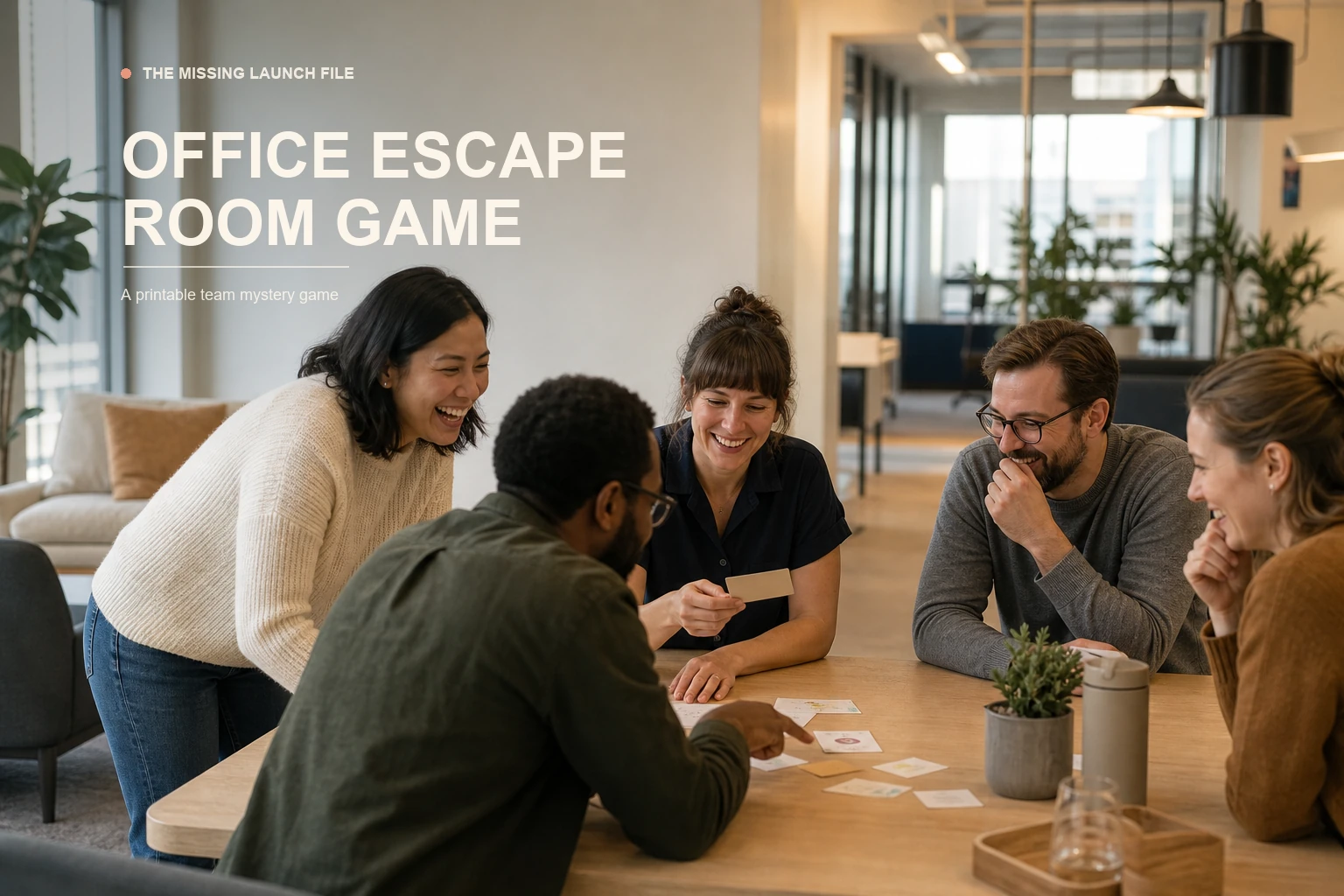
The Missing Launch File office escape room fits the shared-challenge block; the Team Building Activity Cards can supply the opening and shorter alternatives.
Frequently asked questions
Do we need a winner?
No. Competition can add energy, but collaboration practice often works better with a shared finish or a time target rather than team ranking.
Should managers participate?
Usually, if their presence will not silence the group. A manager can also host or observe, but should be clear about the role.
What should be recorded?
Record only the final work agreement and operational follow-up. Do not turn casual comments into performance notes.