Office & Team Games
Printable Team Building Activities for Work: A Practical Guide
A practical way to choose work-friendly printable activities by time, group size, meeting goal, and how much hosting effort is realistic.
The short answer
Choose the smallest printable activity that fits your meeting goal.
Use quick cards when you need a short warm-up. Use a puzzle or mystery game when you want a stronger shared challenge. Use structured worksheets when the meeting needs a work outcome, such as planning, reflection, or prioritization.
The best team activity is not always the loudest one. For a real meeting, workshop, or onboarding session, the better question is simpler: what do you need this group to do in the time you actually have?
Maybe you need a five-minute reset before a planning session. Maybe a group of new hires needs something collaborative that does not feel like forced personal sharing. Or maybe you want a small-group challenge that gives people a finished moment together.
Printable activities can help because they are easy to prepare, easy to explain, and easy to scale. The format matters, though. A five-minute prompt card and a 25-minute mystery game solve different problems.
Start with four questions
Before you download or print anything, decide:
- How much time do we really have?
- How many people will play together?
- What is the purpose of the activity?
- How much host effort is realistic?
Those answers will usually narrow the choice faster than browsing dozens of random activity lists.
Format 1: Quick energizer cards
Best for short meetings, lunch-and-learns, recurring check-ins, or a quick reset after a heavy discussion.
These are usually simple prompt, choice, or discussion cards. A host reads one, pairs or small groups respond, and the activity moves on. The best versions are clear enough that nobody needs a long explanation.
Choose this format when:
- you have 5 to 10 minutes;
- the group already knows each other a little;
- you need a light reset, not a full game;
- you want minimal printing.
Avoid prompts that are too personal. “Tell us your most embarrassing moment” may be memorable, but it is not a neutral way to start a work meeting.
Format 2: Collaborative puzzle or mystery game
Best for onboarding, workshops, offsites, retreats, or any meeting where you want a more memorable group activity.
A puzzle or mystery game gives the group one fictional problem to solve together. People can compare notes, notice patterns, divide small tasks, and make a final decision. This often feels more natural than a traditional icebreaker because the focus is on the shared task, not on personal performance.
Choose this format when:
- you have about 20 to 30 minutes;
- the group can split into teams of 3 to 8;
- you want participation without putting anyone on the spot;
- one person can host, track time, and release the next clue.
Look for a kit that separates player materials from host-only pages. If the answer key is mixed into the handouts, the activity becomes harder to run and easier to spoil.
If you already know you want this format, you may also like our guide on how to run a printable escape room for team building at work.
Format 3: Onboarding activities
Best for new-hire groups, cross-team introductions, and first workshop sessions.
The goal is not to make strangers reveal everything about themselves. A better early activity gives them a simple shared task and a reason to talk. This could be a low-pressure puzzle, a choose-your-path discussion, or a work-scenario card activity.
Choose this format when:
- participants do not know each other well;
- you want the conversation to stay professional;
- the host can explain the task in under two minutes;
- the activity does not depend on company trivia or inside jokes.
Skip anything that expects new people to know the culture before they have even joined it.
Format 4: Workshop reflection or decision worksheets
Best for planning sessions, project kickoffs, retrospectives, and small working groups.
These are not always games. They are printable structures that help a group sort ideas, choose priorities, or reflect on a project without starting from a blank page.
Choose this format when:
- the meeting has a real work outcome;
- participants need to contribute ideas in a structured way;
- a simple worksheet is more useful than a competitive activity;
- the host has time to explain what happens after people fill it in.
A beautiful worksheet is not enough. People need to know what to write, how long they have, and what the answers will be used for.
Quick chooser
| If you need… | Try… | Typical time | Host effort |
|---|---|---|---|
| A quick meeting reset | Energizer cards | 5 to 10 minutes | Very low |
| A shared small-group challenge | Puzzle or mystery game | 20 to 30 minutes | Low to moderate |
| A first-day conversation starter | Low-pressure onboarding activity | 10 to 20 minutes | Low |
| A structured work discussion | Reflection or decision worksheet | 15 to 45 minutes | Moderate |
Choose the simplest format that genuinely fits the time and purpose. A clear small activity is better than a complicated one the host has to rescue halfway through.
What makes a printable activity work-safe?
“Fun” means different things to different people. In a workplace, the safer starting point is an activity that is:
- easy to explain;
- respectful of quieter people;
- free from embarrassing personal questions;
- usable without alcohol, physical challenges, or special equipment;
- clear about time, materials, and rules;
- easy for a host to start and stop.
The goal is not to force a big personality moment. It is to give people a small, shared reason to interact.
Why ready-to-use can be worth paying for
ChatGPT can give you activity ideas quickly. The question is whether those ideas are ready for a real meeting.
Someone still has to check the rules, remove confusing steps, make sure the pages print correctly, separate host answers from player materials, and turn the idea into something that looks polished instead of rushed. That work is easy to underestimate until you are fixing a file the night before a workshop.
If you enjoy building activities, making your own can be satisfying. If you need something practical now, a ready-to-use kit gives you files, instructions, print options, and a clearer host path from the start.
Printable team mystery
A printable team mystery for small groups
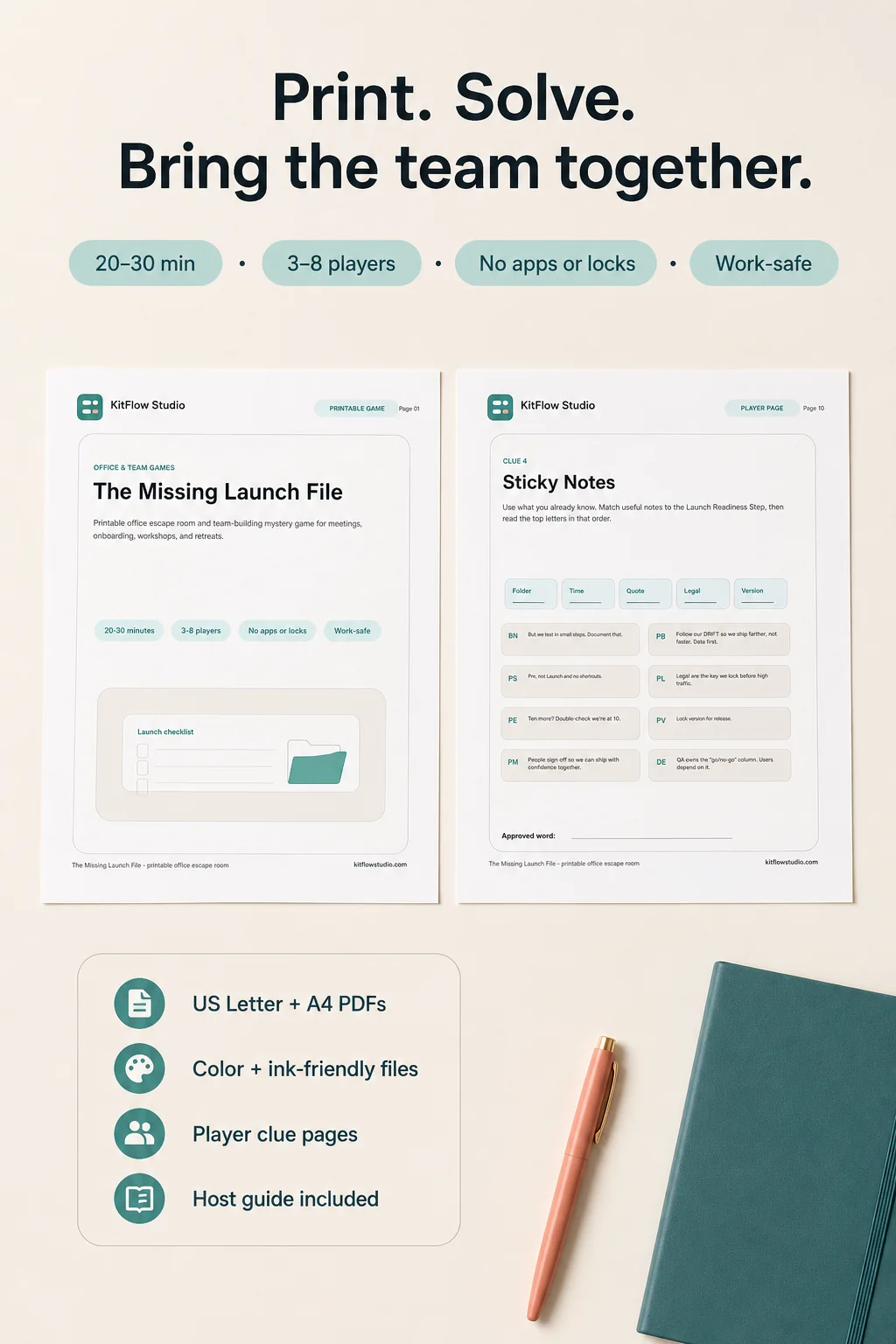
The Missing Launch File is a printable office mystery and team-building game for meetings, onboarding sessions, workshops, retreats, and small office events.
It works best with 3 to 8 players per packet, uses a default 25-minute timer, and includes US Letter and A4 PDFs, color and ink-friendly versions, player pages, host guidance, hints, an answer key, timer cues, and support information.
It is a digital download only. No physical item is shipped.
Frequently asked questions
Do printable team building activities work for large groups?
They can, but most printable games work better when a large group is split into smaller teams. Give each team its own packet and explain how answers will be checked without teams overhearing each other.
Do we need a color printer?
Not always. Check the product details before buying. Some kits, including The Missing Launch File, include ink-friendly versions for practical office printing.
Are printable activities only for office parties?
No. They can also fit onboarding, workshops, retreats, training breaks, and team meetings. The right use depends on the format and the group.
What makes a team activity feel awkward?
Usually unclear rules, pressure to perform, or questions that ask people to share more than they want to share at work. A shared task with a clear goal is often easier for mixed groups.
Should I use one activity for every team?
No. A small leadership workshop, a new-hire group, and a casual office party may need different formats. Start with time, group size, and purpose.