Tax-Season & Quarter-Close Team Building Games Accounting Teams Don’t Hate
Announce a “mandatory team-building activity” the morning after a brutal April 15 filing deadline or a 10-day Q3 close, and you can feel the collective exhaustion in the room before anyone even opens a slide deck. Accountants, tax specialists, FP&A analysts, controllers, and internal auditors spend their days reconciling discrepancies, spotting missing purchase orders, and verifying internal controls under tight deadlines. Asking those same professionals to play middle-school party trivia, pantomime charades, or forced “share a quirky fact about yourself” icebreakers usually lands with a polite, strained smile—and a quiet wish that the meeting would end early.
Yet CFOs, controllers, and finance managers still face a real operational need: after weeks of heads-down spreadsheet sprints, reconciliations, and late-night close calls, teams benefit from a shared, low-stakes win where AP, AR, Treasury, Tax, and FP&A actually talk to one another without an urgent audit request hanging over their heads.
The secret to a finance team activity people genuinely enjoy is simple: respect how analytical people think. Trade forced vulnerability and cheesy party prompts for a structured, 25–35 minute tabletop forensic audit mystery where teammates split authentic-looking ledgers, spot control overrides, and crack a case together over lunch.
Quick Answer: What Makes a Finance Team Building Game Actually Work?
| Design Element | Why Generic Icebreakers Bomb in Finance | What Works for Accounting, Tax & Audit Teams |
|---|---|---|
| Intellectual Respect | Relies on awkward personal sharing, acting, or pop-culture trivia | Relies on timestamps, sequence gaps, threshold rules, and cross-checking |
| Table Participation | One loud talker dominates—or one fast solver finishes a single worksheet alone | Asymmetric evidence packets require teammates to trade clues out loud |
| Host Prep Burden | Managers spend an hour cutting paper slips, stuffing envelopes, or configuring apps | Turnkey 2-minute print setup: one 8-page packet per table, zero cutting |
| Cross-Team Inclusion | Alienates quiet analysts or excludes non-CPA guests with exam jargon | Zero CPA trivia required—HR, Ops, and PM guests collaborate on equal footing |
| Post-Game Atmosphere | Turns a social break into a disguised performance lecture | High-energy reveal + optional lighthearted conversation prompts |
Why Traditional Office Games Backfire With Accounting & Audit Squads
When controllers or finance operations leads ask why past offsite games fell flat, three patterns show up over and over again:
1. The “One Spreadsheet Whiz, Five Spectators” Problem
Many printable office games put every clue onto one linear worksheet. In a room full of sharp analysts, whoever reads fastest grabs the page, solves three steps silently in their head, and announces the answer while four teammates sit back checking their phones. Good tabletop design prevents that structurally: if four people hold four distinct financial artifacts, nobody can finish without talking across the table.
2. Fake “Accounting Trivia” That Feels Like Continuing Education
Nobody wants a celebratory quarter-close lunch to feel like a surprise CPA Ethics or ASC 606 pop quiz. Even worse, jargon-heavy trivia immediately sidelines payroll coordinators, new hires, summer interns, or cross-functional partners from Product and Legal who joined the offsite. The best finance mysteries use the authentic setting of quarter-close—invoices, POs, wire queues, badge logs, and approval thresholds—while keeping every deduction rooted in pure, universal logic.
3. Too Much Facilitator Prep During Busy Season
If a controller or office manager is hosting a tax-season wrap-up on Friday afternoon, they do not have 45 minutes to print double-sided puzzle cards, cut out tokens with scissors, hide envelopes around a conference room, or troubleshoot a clunky browser escape-room app on corporate Wi-Fi. A printable game has to work straight out of the office laser printer in two minutes flat.
The 35-Minute Quarter-Close Tabletop Blueprint
Whether you are hosting an 8-person boutique tax firm or a 40-person corporate finance department split across tables, a forensic audit tabletop mystery drops cleanly into a single 45-minute lunch or offsite block:
Step 1: Print and Deal (Minutes 0–3)
Print one loose 8-page evidence packet for every table of 3–6 people. Keep the facilitator’s Answer Key private on a tablet or clipboard. Instead of letting each table read Pages 1 through 8 from top to bottom like a textbook, instruct every squad to immediately deal the four primary exhibits to four different people:
- Player 1: Vendor Invoice & Purchase Order Register
- Player 2: Treasury Wire Batch & Physical Badge Custody Log
- Player 3: Dual-Control Payment Routing Flow & Threshold Policy
- Player 4: Corporate Card Exceptions, Gateway Log & War-Room Slack Thread
Step 2: Cross-Examine Across Roles (Minutes 3–25)
Because no single page holds enough information to solve the case, natural conversation starts within 60 seconds—without a single forced icebreaker prompt. Player 1 spots an out-of-sequence invoice with no Purchase Order and a hijacked hardware token; Player 2 checks who was actually in the building when that token fired; Player 3 translates an internal IP address and GL clearing code using a visual routing map; Player 4 catches a $0.00 corporate card onboarding test that blows up a suspect’s Slack alibi.
Notice what is happening at the table: quiet analysts speak up because they literally hold the only copy of an essential clue. Nobody has to perform, and nobody is left out.
Step 3: Synthesize & Submit Quietly (Minutes 25–30)
All teammates gather around a shared Cross-Team Correlation Grid and a 4-Digit Freeze Code matrix, combining one piece of proof from each exhibit to lock in their final submission sheet. Winning tables bring their sheet quietly to the host desk rather than shouting out the answer, letting slower tables enjoy their own “aha” moment.
Step 4: Sixty-Second Reveal & Light Debrief (Minutes 30–35)
Read a crisp 60-second case resolution script crowning the fastest clean solve (with tiny time adjustments if a table used progressive hints or made a hasty wrong guess). Close with one optional, blameless laugh—for example, “Which single contradiction broke the case open at your table?”—and let people enjoy the rest of their lunch.
Five Controls That Make a Finance Mystery Feel Real (Without Homework)
If you want to evaluate a printable finance game—or design a custom internal tabletop drill—look for these five details that finance pros immediately appreciate:
- Invoice Sequence Gaps: Real AP auditors notice immediately when
INV-6092jumps straight toINV-6094withINV-6093mysteriously missing. It takes zero accounting formulas to spot, yet feels unmistakably authentic. - Three-Way Match & NO-PO Overrides: Requiring a Purchase Order, Receiving Receipt, and Onboarded Vendor file makes intuitive sense to anyone who has ever bought software or office supplies—and instantly flags a rush shell-vendor disbursement.
- Dual-Control Threshold Tiers: Showing why a $48,500 wire normally requires Controller + VP Finance signoff—unless overridden from a specific physical console—turns policy tables into an engaging deduction map.
- Physical Badge Logs vs. Digital Claims: Nothing beats catching a suspect who claims on Slack at
21:39that they “didn’t touch the console,” when physical badge swipes show them inside the secured room from21:30to21:39and a Corporate Card pre-auth exposes their vendor setup six minutes earlier. - Eco-Ink Office Laser Safety: Finance offices run on high-speed black-and-white laser printers. Any printable kit worth buying should include a true 0%-color monochrome edition on pure white backgrounds so tables stay razor-sharp without draining color toner.
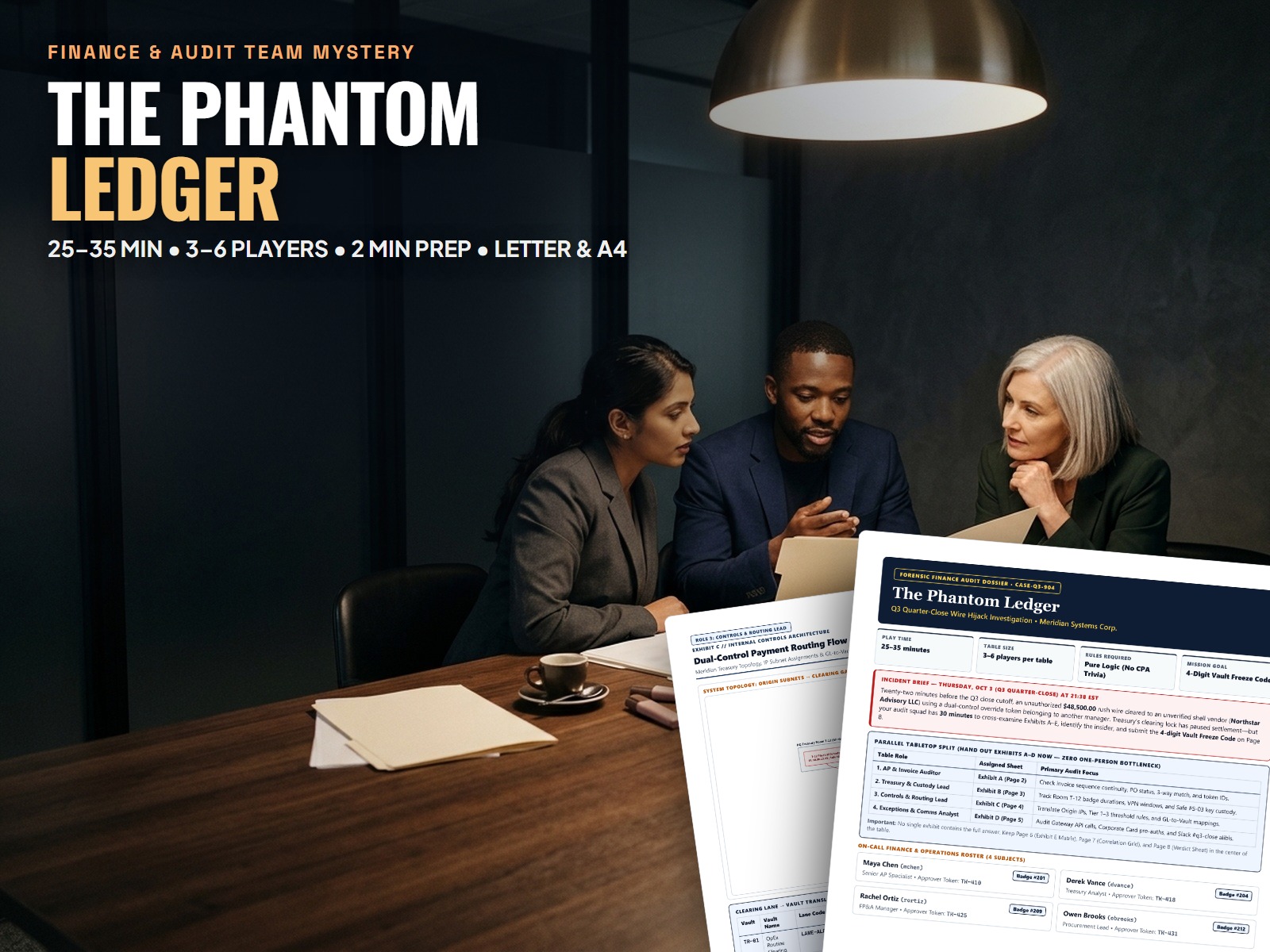
Ready-to-Run Option: The Phantom Ledger: Finance & Audit Forensic Mystery
If you want a completely turnkey, mathematically verified option for your next tax-season wrap-up, Q3/Q4 close celebration, or finance department offsite, check out The Phantom Ledger: Finance & Audit Forensic Mystery.
- Play Time & Group Size: 25–35 minutes for 3–6 players per table (includes a 10-table tournament scoreboard for larger departments).
- Zero Prep: 2 minutes to print and hand out—no scissors, props, or external apps.
- Mathematically Verified Fairness: Every clue across Exhibits A–E has been formally verified so there is one unique 4-digit Vault Freeze Code and zero skippable exhibits.
- Complete Print Bundle: Instant ZIP with US Letter & A4 PDFs in both Full Color and dedicated 0%-color Eco-Ink Monochrome, plus a separate 6-page Host Master Guide featuring a 60-second opening script, 3-tier non-spoiler hint ladder, and hybrid Zoom/Teams breakout instructions.
Frequently Asked Questions About Finance & Accounting Team Games
How long does a printable finance team building game take from start to finish?
Plan for a 35–40 minute total block inside a 45–60 minute lunch or offsite session: 2–3 minutes to deal the exhibits and read the 60-second opening script, 25–30 minutes of table investigation, and 5 minutes for final code verification and the closing reveal.
Can small teams (3 people) or large finance departments (25+ people) play?
Yes. Each table works best with 3–6 players. For larger departments of 12, 24, or 40 people, split everyone into tables of 4–5 and run a friendly multi-table race using the included Host Leaderboard, adding tiny 2–3 minute time adjustments for Tier 2/3 hints or incorrect submissions.
What if half our accounting team works remotely on Zoom or Microsoft Teams?
Asymmetric tabletop packets adapt cleanly to virtual breakouts: share the Player PDF inside your closed internal channel, assign Exhibits A, B, C, and D to four different teammates in each breakout room, and have one person screen-share the shared Correlation Grid while everyone calls out clues from their own sheet.
Give your team a break that respects their brains—and watch how fast a quiet room of accountants turns into a sharp, laughing war room.