How to Choose a Printable Game for Four Adults
A printable game for four adults should fit the people and the table you actually have. Before choosing one, check whether four means exactly four, whether the host plays, and what needs printing or cutting. Those details matter more than a cheerful cover image when you are planning an evening at home.
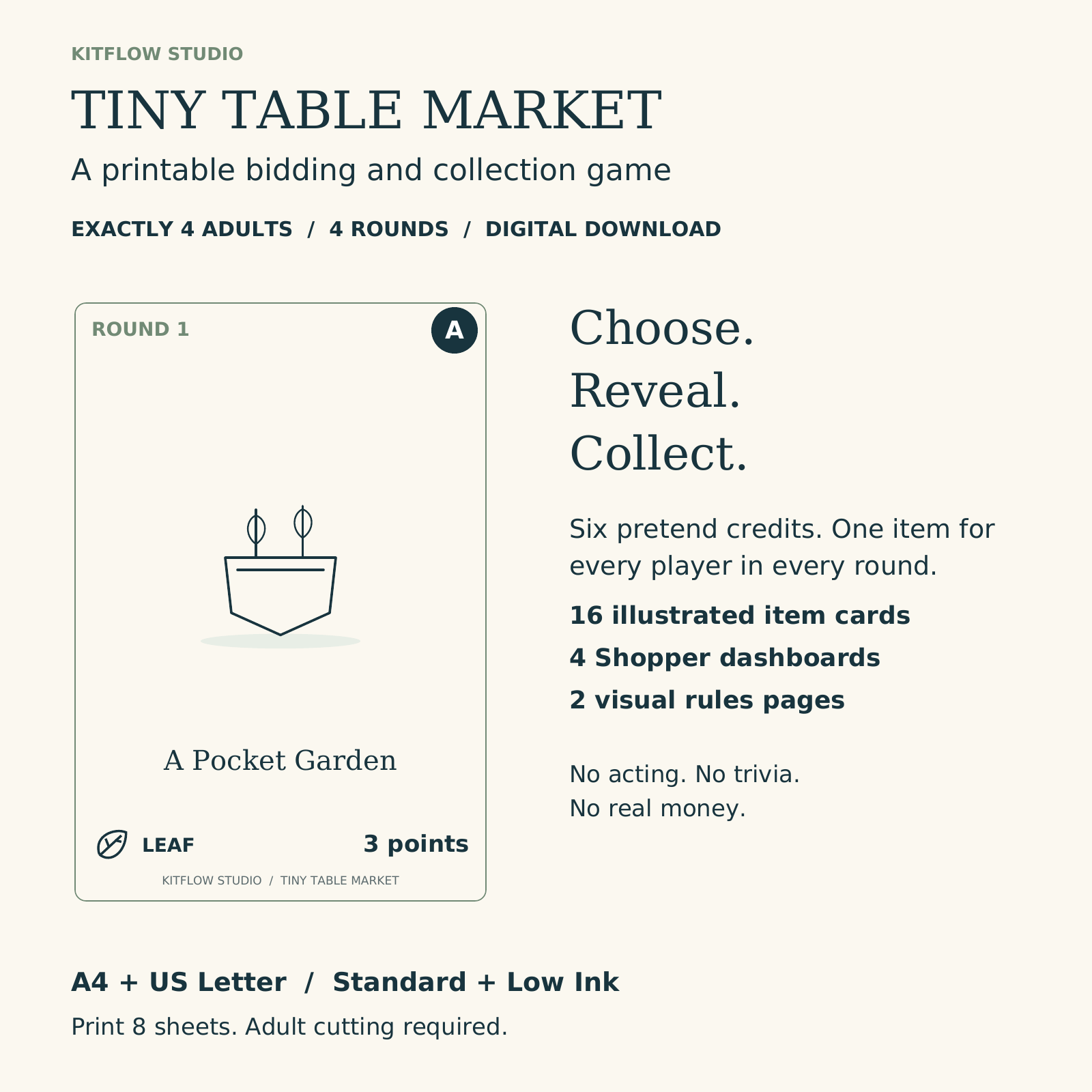
Use the checks below to decide what suits your gathering. There is also a free paper activity you can make yourself, followed by a closer look at Tiny Table Market, a bidding and collection game designed for exactly four adults.
Start with the kind of participation you want
Ask what everyone is willing to do. Would they like to make private choices and compare outcomes, or would they rather build something together without a winner? Is writing comfortable for everyone? Does anyone want to watch rather than play? Pick a format around those answers instead of expecting a guest to fill a seat.
Check whether the host is included in the stated player count. A game for four players plus a separate facilitator needs five people. Tiny Table Market includes the host among its four players and does not require a separate game master. It has no three-player or dummy-seat version, so it needs four willing adults throughout.
Check preparation before downloading
Digital delivery does not mean the materials are ready for the table. Read the page count, cutting instructions and paper-size options before you buy. If you do not have a printer or cannot prepare the pieces ahead of the gathering, choose a different format.
- Choose the PDF that matches your paper. A4 and US Letter are different formats.
- Check the print-scaling instruction. For Tiny Table Market, use 100% or Actual Size, not Fit or Shrink.
- Count the pieces you must cut, not just the sheets you must print.
- Leave time to read the rules and worked example before inviting everyone to begin.
Tiny Table Market has four complete English editions: A4 and US Letter, each in Standard and Low Ink. Print only one eight-page edition, single-sided. Cut sixteen item cards and four shopper dashboards, leaving the two rules pages whole. You also need scissors for preparation and four pencils. Color is not essential to play.
Measure the usable table area
Put aside room for drinks before laying out a paper game. Check whether each player can see shared information and keep their own pieces separate. A game name is not a measurement.
For Tiny Table Market, the sixteen-card market alone measures 42 × 59.4 cm on A4, or 43.18 × 55.88 cm on US Letter, before gaps between cards. Four dashboards, four collections and the rules need additional space. Despite its name, this layout is not intended for a tiny cafe table.
Try a free four object exhibit
For a homemade alternative, give each person a pencil and a scrap of paper. Together, choose a harmless imaginary exhibition theme, such as “Things for a rainy afternoon.” Each person writes or sketches one invented object for the exhibit. It can be as ordinary as a mug or as unlikely as a cloud-shaped chair.
- Place the four papers where everyone can see them. Anyone may leave their paper blank and pass.
- Offer each person a turn to name their object. No explanation or personal story is required.
- Arrange the papers into one shared exhibit and invent a title together.
- If the group wants another round, choose a new theme. Otherwise, finish with the exhibit as it is.
There are no bids, points or winners. This is an original open-ended activity suggestion, not a sample round of the paid game. Use it when your group wants to make something together rather than compete for cards. Keep the theme fictional if anyone would rather avoid sharing personal preferences.
Decide whether a bidding game fits
Tiny Table Market uses pretend credits, not real money. Each player starts with six credits for the whole game. Across four rounds, players privately choose a current-round item and write a bid from zero to three within their remaining credits, then reveal together. Each person receives one item per round. The final score combines printed card points with one collection bonus.
The trade-off is what makes this format different from the free exhibit: you choose how much of a limited budget to spend on a collection. Other players may want the same item. Randomly drawn priority resolves tied highest bids, and priority is drawn again each round. It is not guaranteed to rotate evenly. Read the complete rules rather than treating this overview as instructions for play.
Know the limits before buying
Tiny Table Market is a US$6 digital download with no physical materials shipped. Printing and cutting are required. It has not been human-playtested: duration, learning burden, enjoyment, age suitability and balance have not been validated. There is no play-time or fairness guarantee.
If one person stops, pause and resume another time or end unscored; do not add a dummy player or ask someone to run two seats. Choose it only if the exact player count, preparation and competitive format suit your group. Review those requirements before purchasing, and keep the free exhibit in mind when you prefer an open-ended activity.