For Families
12 Questions to Ask at a Parent–Teacher Conference When You Only Have 15 Minutes
Twelve parent–teacher conference questions organized around the information a family needs to understand progress and agree on a next step.
The useful rule
Bring three questions, not twelve. Choose one about progress, one about what the teacher observes that you cannot see at home, and one about the next step. The full list below is a menu for preparation, not a script to finish before the bell.
Before choosing questions, ask your child
Try: “What feels easiest at school right now?”, “What feels harder than you expected?”, and “Is there anything you want me to understand before I meet your teacher?” Do not promise secrecy you may not be able to keep if a safety concern emerges, but explain how you will represent their view.
Write down one concern and one encouraging thing your child said. This keeps the meeting from becoming a report delivered around the student rather than a conversation about them.
12 questions worth considering
Progress and evidence
- What is one recent example of progress you have noticed?
- What does expected progress look like at this point in the year?
- Where is my child using a skill independently, and where do they still need prompting?
- Is there a work sample or classroom pattern that would help me understand what you are seeing?
Experience and participation
- When does my child seem most engaged in class?
- What tends to happen just before they become stuck or withdraw?
- How do they participate in group work, transitions, and less structured parts of the day?
- What is something about my child at school that I may not see at home?
Support and next steps
- Which strategy is helping now, and how consistently is it being used?
- What is one reasonable thing we can reinforce at home without recreating the school day?
- If the concern continues, what is the school’s normal next step and who should we contact?
- What will we look for, and when should we check in again?
Questions to adapt, not ask literally
| Instead of… | Try… | Why |
|---|---|---|
| “Is my child doing okay?” | “What is one strength and one current priority?” | Invites specific evidence |
| “Why are they not trying?” | “What do you observe before the work stops?” | Separates observation from motive |
| “What should I make them do?” | “What home support would reinforce the classroom strategy?” | Creates alignment without blame |
| “Can you guarantee improvement?” | “What change would tell us the plan is helping?” | Defines review evidence |
Leave with a small, shared plan
Before the meeting ends, repeat the agreement in plain language: the priority, what the school will do, what the family will do if appropriate, who owns each action, and the review date. Ask which communication channel the teacher can realistically maintain.
If a concern needs more time, a specialist, interpretation, accessibility support, or a formal school process, schedule the correct follow-up. A 15-minute conference does not need to contain the entire solution.
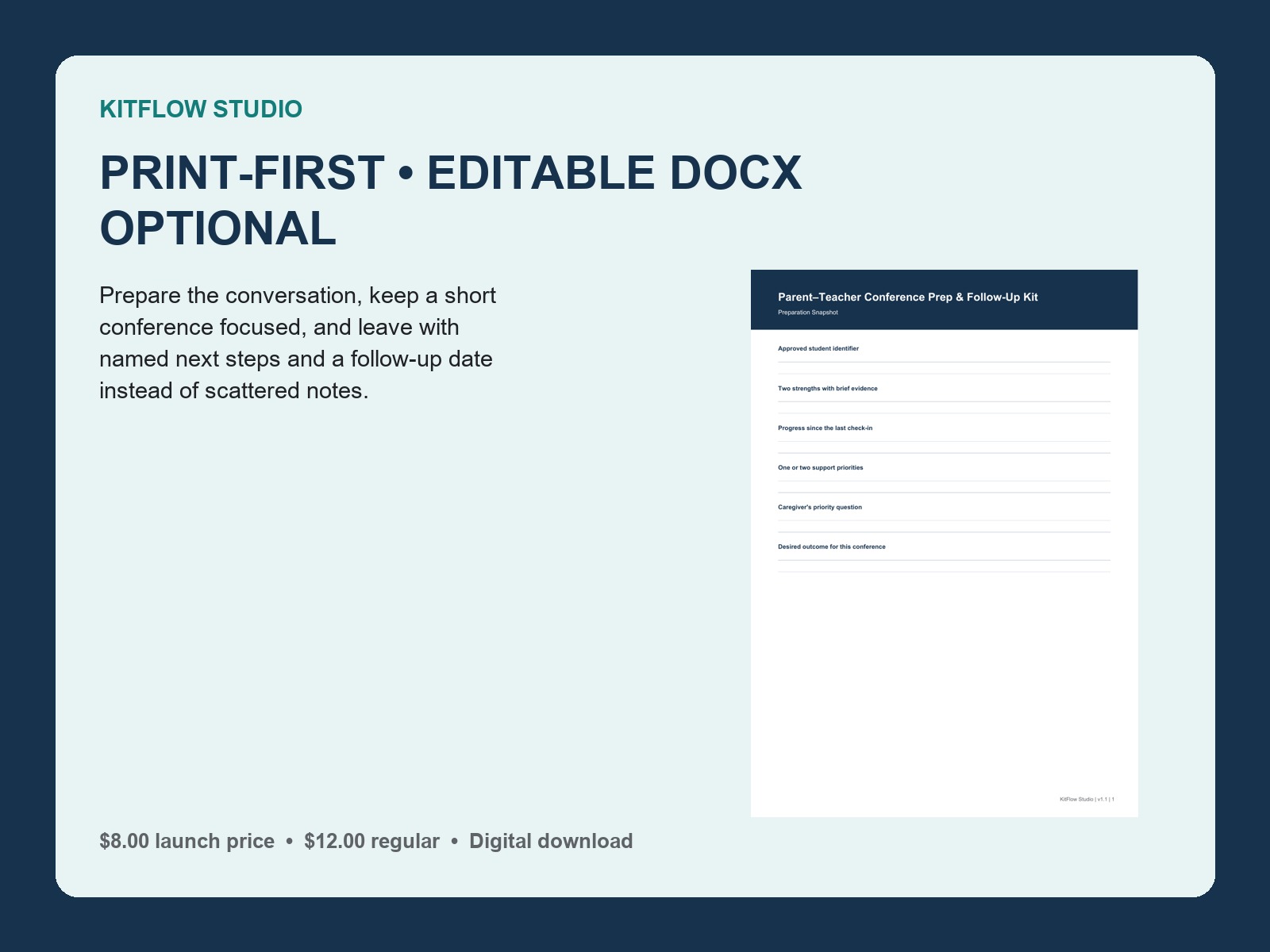
The Parent–Teacher Conference Prep & Follow-Up Kit provides printable preparation and follow-up pages. The related guide How to Prepare for a 15-Minute Conference gives a complete before-during-after sequence.
Frequently asked questions
Should I bring every report and assignment?
No. Bring one or two items that clarify your question. The teacher may already have the most relevant classroom evidence.
What if I disagree with the teacher?
Ask which observation or record supports the conclusion, share what you see at home, identify where views differ, and agree on the next information or process needed.
Should my child attend?
Ask the school and consider age, purpose, and the child’s needs. If they attend, prepare them for their role and avoid surprising them with sensitive topics.
Sources and further reading
See the NYC Public Schools family conference guide, the U.S. Department of Education-supported family question checklist, and Edutopia’s two-way conference guidance.