How to Host an Effortless 60-Minute Office or Neighborhood Pub Trivia Night
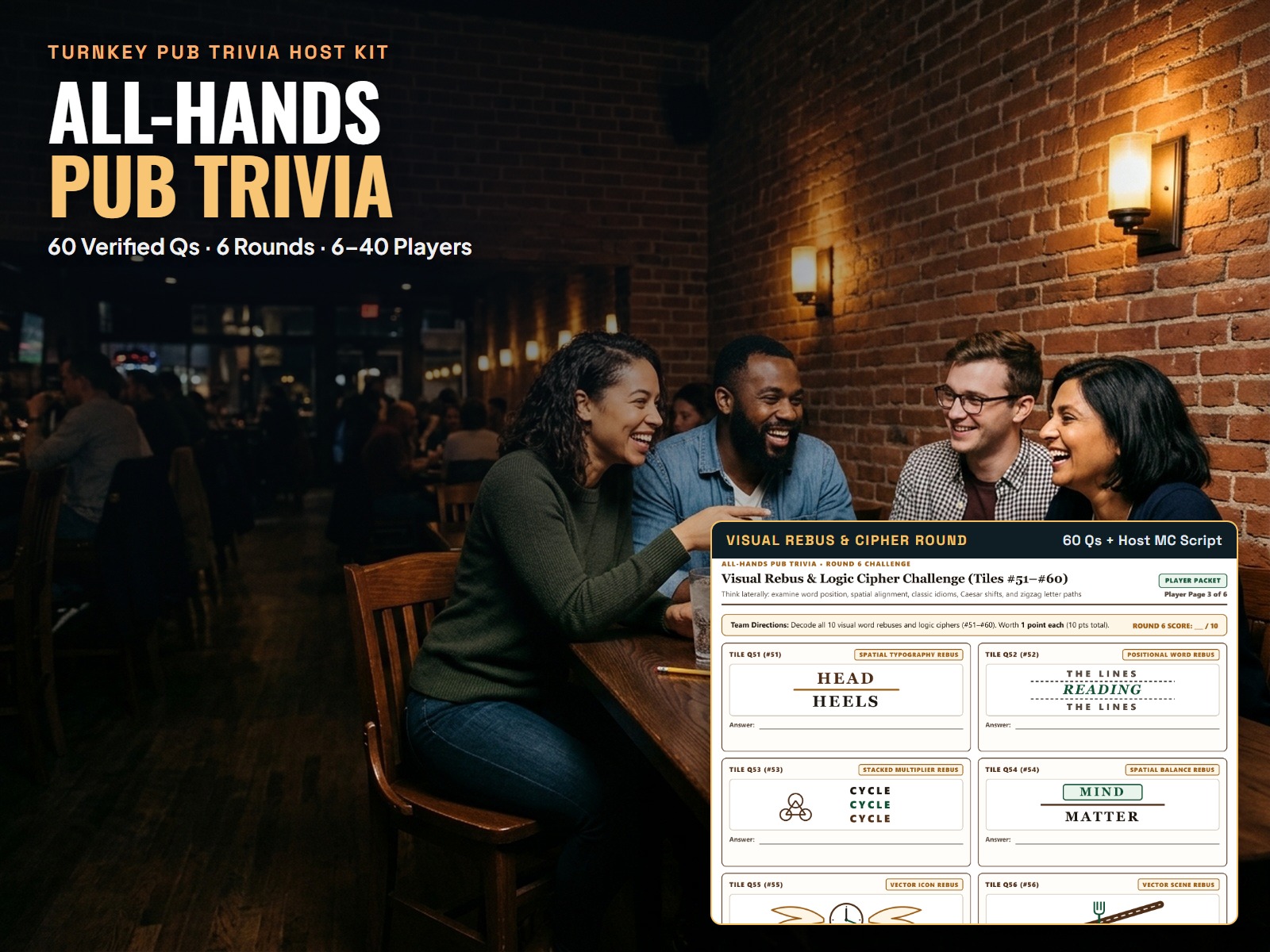
Running a pub trivia night sounds simple until Tuesday afternoon arrives and you realize you still need 60 balanced questions, clean answer sheets, a tiebreaker nobody can look up mid-debate, and a scoring workflow that does not stall after Round 2. Most first-time organizers spend four to six hours pulling half-remembered facts off the internet—only to discover during Round 3 that two questions have outdated statistics or ambiguous answers.
With a structured printable pub trivia night host kit and a repeatable 60-minute run-of-show, you can walk into a conference room, breakroom, living room, or neighborhood taproom with 2 minutes of prep and keep 6 to 40 guests laughing from the opening welcome to the championship callout.
Why Most DIY Trivia Nights Drag Past 90 Minutes (and How to Fix It)
When an office social committee or neighborhood host improvises trivia from scratch, three bottlenecks almost always derail the energy:
- Unbalanced Question Difficulty: Five hyper-obscure sports or music questions in a row leave half the room checked out. A balanced night mixes evergreen general knowledge—World Landmarks, Everyday Inventions, Food Origins, Film Soundtracks, and Logic Puzzles—so every teammate has a moment to carry the table.
- Slow Collection & Grading: If one host collects 10 loose sticky notes per round and tries to read handwriting while shouting over conversation, the room loses momentum between rounds.
- Weak Endings & Tiebreakers: Nothing deflates a great trivia night faster than a two-way tie settled by a coin flip or an improvised “guess a number between 1 and 100.”
The solution is treating the night like a well-paced broadcast: 6 crisp 10-question rounds, 1 visual puzzle round, a Double-Points Final Wager, and a pre-printed numerical tiebreaker.
The 60-Minute Pub Trivia Blueprint (Minute by Minute)
Whether you are hosting an all-hands team social for 36 coworkers or a Friday night living-room tournament for 12 neighbors, this exact pacing keeps energy sharp without rushing table conversation:
| Clock | Segment | Host Action & Room Flow |
|---|---|---|
| 00:00 – 03:00 | Welcome & Team Setup | Distribute 1 Team Packet per table (teams of 2–6). Read the 60-second opening rules, ask everyone to place phones face-down, and give teams 2 minutes to choose a team name. |
| 03:00 – 11:00 | Round 1: World Landmarks & Geography | Read 10 crisp, verifiable geography questions twice each, leaving 20–30 seconds between prompts for quiet table debate. |
| 11:00 – 19:00 | Round 2: Science & Everyday Inventions | Shift gears into everyday discoveries—why kitchen appliances, elements, and traffic signals work the way they do. |
| 19:00 – 28:00 | Round 3 & Halftime Standings | Run Music & Film Soundtracks, then announce the top three teams at the 30-point mark while players grab drinks or snacks. |
| 28:00 – 36:00 | Round 4: Food & Culinary Origins | High-participation crowd-pleaser covering classic dishes, spices, and regional culinary stories. |
| 36:00 – 44:00 | Round 5: Sports Logic & Everyday Numbers | Fast numeric round where teams lock in classic regulation rules, cards, dice, and measurements. |
| 44:00 – 52:00 | Round 6: Visual Rebus & Logic Cipher | Hand the room 6 uninterrupted minutes to solve printed visual wordplay, Caesar shifts, and zigzag letter puzzles while you update the Master Leaderboard. |
| 52:00 – 60:00 | Double-Points Final Wager & Crown Winners | Announce only the Final Category, lock wagers (0–10 points), read the Final Wager question, break any ties with the pre-printed estimator, and announce the podium. |
Need a 45-Minute Lunch-and-Learn Version? Trim the fun-fact readouts after individual questions, reveal Round 1–3 answers in one batch at halftime, and set a 4-minute timer for Round 6. The structure stays identical, and you finish right on the hour with time to spare.
Choosing Your Grading Style: 6–16 Players vs. 16–40 Players
One size does not fit every room size. Matching your answer-sheet format to headcount saves at least 12 minutes of dead air:
Option A: Neighbor Table Swap (Best for 6–16 Players)
Each team writes Rounds 1–5 on a single Master Answer Grid. After each round (or at halftime and finale), tables pass their grid one table clockwise to score while the Host MC reads verified answers and one-sentence fun facts. It builds instant room banter and eliminates host grading bottlenecks.
Option B: Cut-Optional 4-Up Turn-In Slips (Best for 16–40 Players)
When five to ten tables are competing in an office cafeteria or local taproom, swapping sheets gets messy. Instead, print 4-up cut-ready round slips so each table tears off and runs a compact Round 1 slip up to the Host scoring table. While teams tackle Round 6’s Visual Rebus Sheet silently for 6 minutes, the Host finishes tallying Rounds 1–5 onto the Master Leaderboard with zero downtime.
Why Round 6 Should Always Be Visual (and Phone-Proof)
By minute 45 of any trivia night, voices are tired and the room appreciates a change of tempo. Switching Round 6 from spoken questions to a printed Visual Rebus & Logic Cipher Challenge accomplishes three things at once:
- Gives the Host MC a Breather: You get 6 quiet minutes to verify scores, double-check arithmetic on the leaderboard, and prep the Final Wager slip.
- Levels the Field for Quiet Thinkers: Teammates who rarely shout out pop-culture trivia often spot spatial wordplay (
HEADstacked aboveHEELS), zigzag letter paths, and+3Caesar ciphers faster than anyone else at the table. - Naturally Deterred from Web Search: Visual rebuses and custom cipher tiles cannot be copy-pasted into a search bar, keeping the room focused on paper, pencils, and collaborative deduction.
(Pro tip: Use crisp vector SVG graphics instead of blurry screenshots or emoji fonts—every line stays razor-sharp on both full-color office printers and black-and-white laser copiers.)
Designing a Fair Double-Points Final Wager & Tiebreaker
A great Final Wager lets trailing teams stay mathematically alive without making the first five rounds meaningless. Here is the cleanest pub-tested formula:
- Reveal Only the Category First: Before reading the Final Question, announce the theme (for example, Astronomy & Navigation). Teams inspect their current score out of 60 and commit a wager between 0 and 10 points on their Final Wager Slip.
- Apply +2× / −1× Asymmetric Scoring: A correct Final Wager earns double the wager (up to +20 points), while an incorrect answer subtracts 1× the wager. A conservative team holding a 7-point lead can wager 2 or 3 points safely, while a 3rd-place squad trailing by 12 points can wager 8–10 points for a dramatic comeback shot.
- Never Improvise Tiebreakers: Print a specific, objective numerical estimator directly below the Final Wager Slip (such as the total ground-to-torch height of the Statue of Liberty in feet) and state upfront that closest absolute distance—above or below—takes the tie. Keep two backup numerical estimators in your private Host Guide in case a three-way tie occurs.
Room Setup & Printer-Friendly Prep Checklist
You do not need buzzers, projector slides, or paid mobile trivia apps to run an unforgettable night. In fact, paper packets keep guests looking at their teammates instead of staring at phone screens.
Two minutes before guests arrive:
- Print 1 Player Packet per 2–6 players (roughly 1 packet per small table or 2 packets for an 8-person conference table).
- Use Eco-Ink Monochrome for High-Volume Office Runs: Choosing a dedicated
#FFFFFF-background monochrome edition preserves crisp black-and-gray hierarchy without draining color toner cartridges on 10+ packets. - Drop 2 Pens per Table: One designated scribe writes while teammates brainstorm—having a backup pen avoids the mid-round pen hunt.
- Keep the Host Master Guide Strictly Private: Store the Host MC Playbook on a tablet, laptop, or clipboard kept face-down at the podium so no answer keys ever cross a player’s line of sight.
Ready to Run Tonight’s Game Without Writing 60 Questions?
If you want all 60 fact-checked evergreen questions, word-for-word Host MC scripts, a 12-team Master Leaderboard, cut-optional 4-up turn-in slips, a 10-tile vector Visual Rebus & Logic Cipher Challenge, and verified US Letter & A4 Color + Eco-Ink editions ready in under two minutes, explore the complete All-Hands Pub Trivia: Complete Host & Team Playbook at KitFlow Studio.